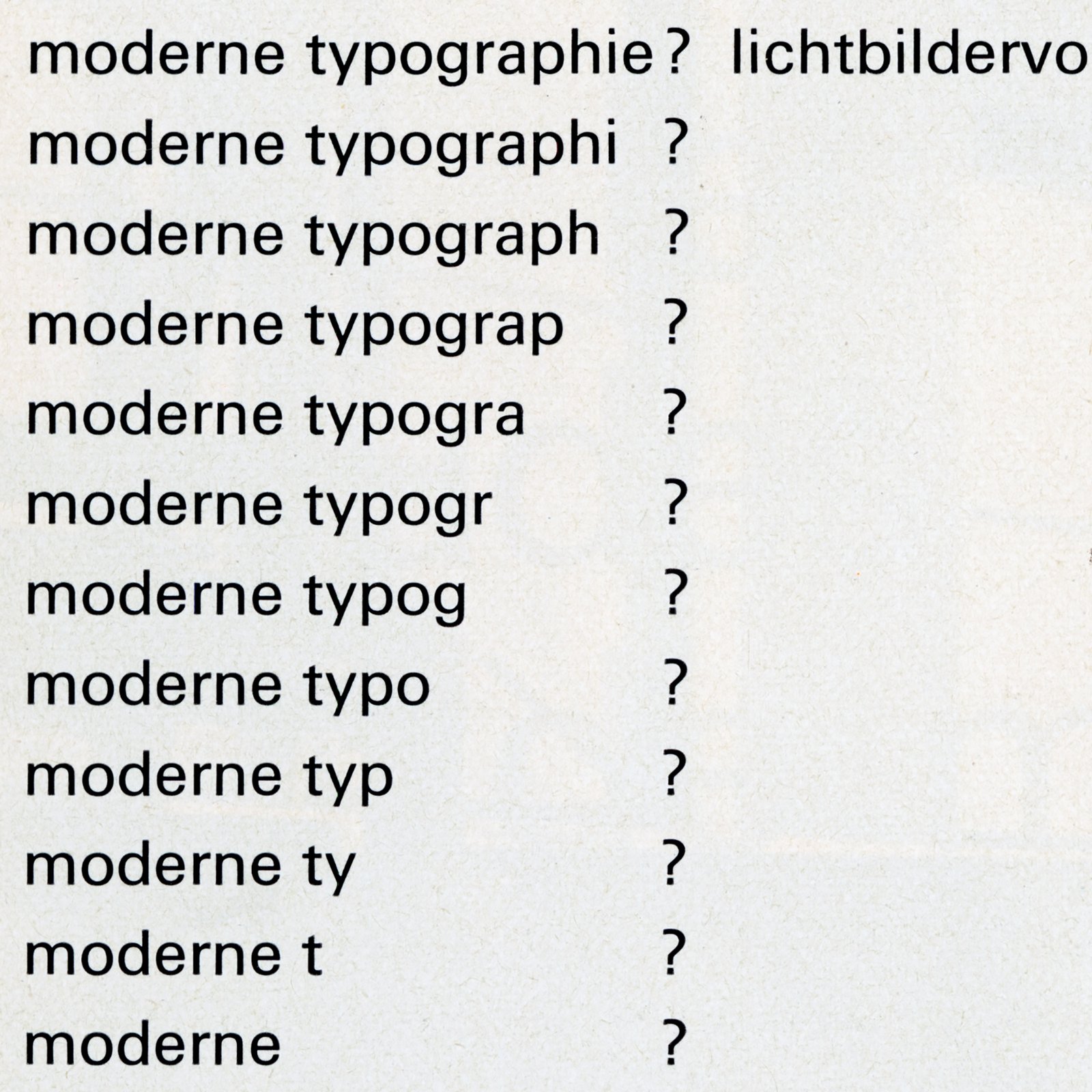
A three-day symposium to examine the repercussions and resistance to New Typography in the French-speaking world.
Employée pour la première fois par László Moholy-Nagy dans le catalogue du Bauhaus de 1923, puis reprise par Jan Tschichold dans son ouvrage Die neue Typographie publié en 1928, l’expression « Nouvelle Typographie » désigne un mouvement d’avant-garde qui tente d’adapter la mise en page et le graphisme aux besoins de son époque.
La Nouvelle Typographie est aujourd’hui considérée comme l’un des marqueurs du tournant moderniste dans le champ graphique, avant de connaître, après la Seconde Guerre mondiale, un renouveau à travers ce que l’on nommera le « style suisse » ou le « style international ».
Impulsé par Catherine de Smet (Université Paris 8) et Davide Fornari (ECAL) le symposium a pour vocation d’élargir le périmètre de l’historiographie en examinant des territoires peu explorés : France, Belgique, Suisse romande, Québec, pays à l’époque sous domination belge ou française du Maghreb ou de l’Afrique subsaharienne. Il vise à confirmer ou infirmer les propositions communément admises (telle l’implantation tardive en France, à partir des années 1960, de la Nouvelle Typographie à travers les « Suisses de Paris »), à émettre des hypothèses et à ouvrir des pistes de travail.
12–14.02.2026
Entrée libre sous inscriptions
Cité internationale des arts
18 Rue de l’Hôtel de ville
75004 Paris
Catherine de Smet, Université Paris 8, UR AIAC
Davide Fornari, ECAL
Chiara Barbieri (ECAL/HES-SO), Sara De Bondt (ECAL), Juanma Gomez (Université Paris 8, UR AIAC), Léa Panijel (ECAL/HES-SO), Sonia de Puineuf (Université Paris 8, UR AIAC9), Tânia Raposo (Université Paris 8, UR AIAC), Alice Savoie (ECAL/HES-SO), Katrien Van Haute (Luca School of Arts, Gand), Thomas Huot-Marchand (Atelier National de Recherche Typographique (ANRT), Nancy)
The expression “New Typography” was the title of an essay by László Moholy-Nagy in the Bauhaus exhibition catalog of 1923, as well as that of the book by Jan Tschichold published in 1928 (Die neue Typographie). It now refers to the avant-garde movement that attempted to adapt graphic design to the needs of its period.
The New Typography was retained by historiography as an emblem of the modernist shift that was taking place in graphic design at the time, and which found a second wind after WW2 with a new, New Typography which merged with the Swiss style or the International Typographic Style. However, the spread and reception of this movement were not uniform. While its effects on the German-speaking and Anglo-Saxon scenes have been fairly extensively studied, in the short and long term throughout the 20th century, research on the reactions it provoked in the French-speaking scenes – adoption, rejection, or negotiation – is less common. The principles, both formal and political, set out by the protagonists of the New Typography such as Jan Tschichold, gave rise to debates, adhesions and resistances, all of which shed original light on the international context from the 1920s to the 1970s.
Initiated by Catherine de Smet (University of Paris 8) and Davide Fornari (ECAL), the goal of this symposium is to broaden the scope of historiography by examining under-explored scenes: France, Belgium, French-speaking Switzerland, Quebec and countries which were at the time under Belgian and French domination in the Maghreb and sub-Saharan Africa. It aims to confirm or refute commonly accepted propositions (such as the late establishment, from the 1960s, of the New Typography in France through the “Suisses de Paris”, that is Swiss designers who had migrated to Paris), to put forward hypotheses and to open up work tracks.
12–14.02.2026
Free admission with registration required
Cité internationale des arts
18 Rue de l’Hôtel de ville
75004 Paris
Catherine de Smet, Université Paris 8, UR AIAC
Davide Fornari, ECAL
Chiara Barbieri (ECAL/HES-SO), Sara De Bondt (ECAL), Juanma Gomez (Université Paris 8, UR AIAC), Léa Panijel (ECAL/HES-SO), Sonia de Puineuf (Université Paris 8, UR AIAC9), Tânia Raposo (Université Paris 8, UR AIAC), Alice Savoie (ECAL/HES-SO), Katrien Van Haute (Luca School of Arts, Gand), Thomas Huot-Marchand (Atelier National de Recherche Typographique (ANRT), Nancy)