String Foundry

String Foundry

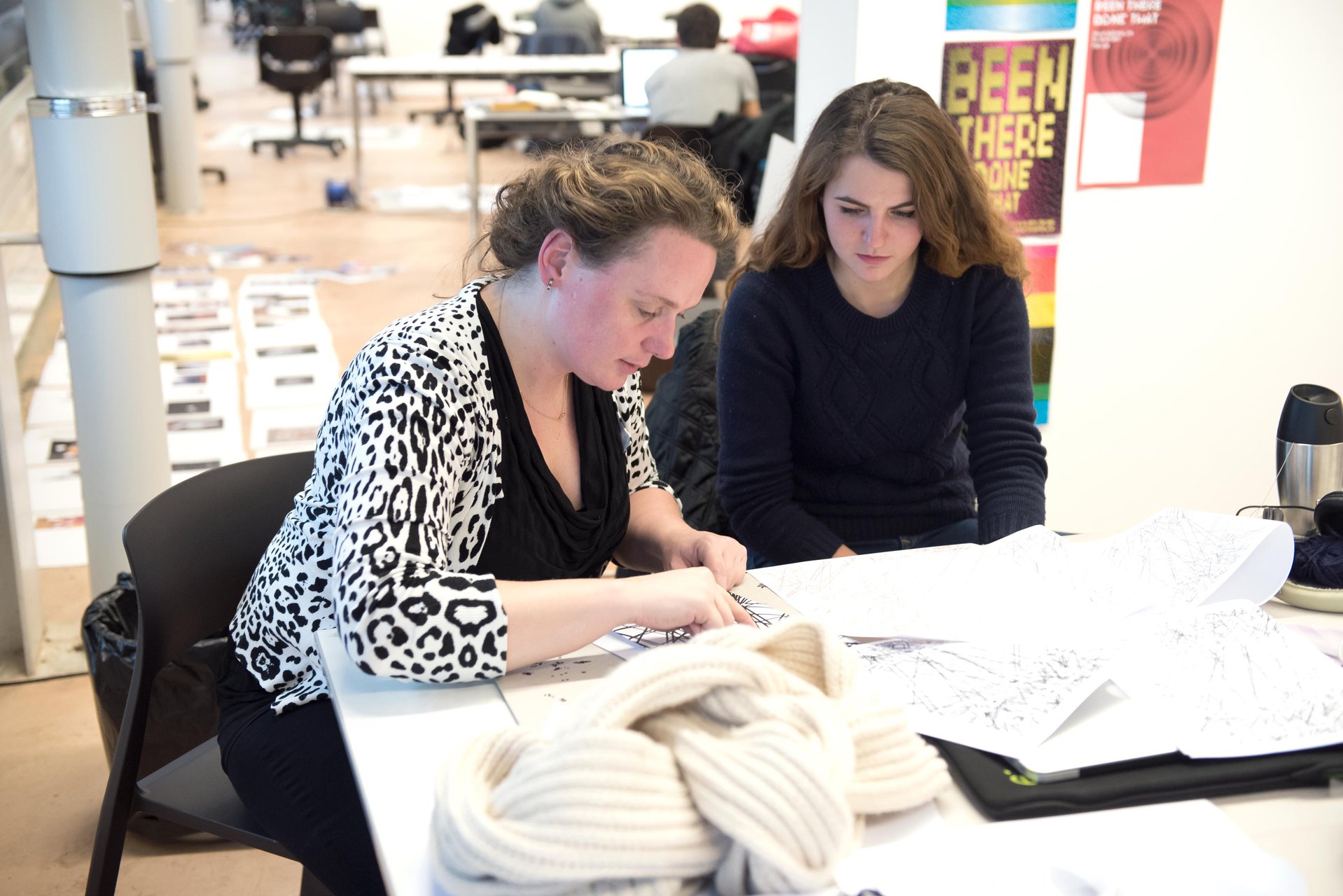
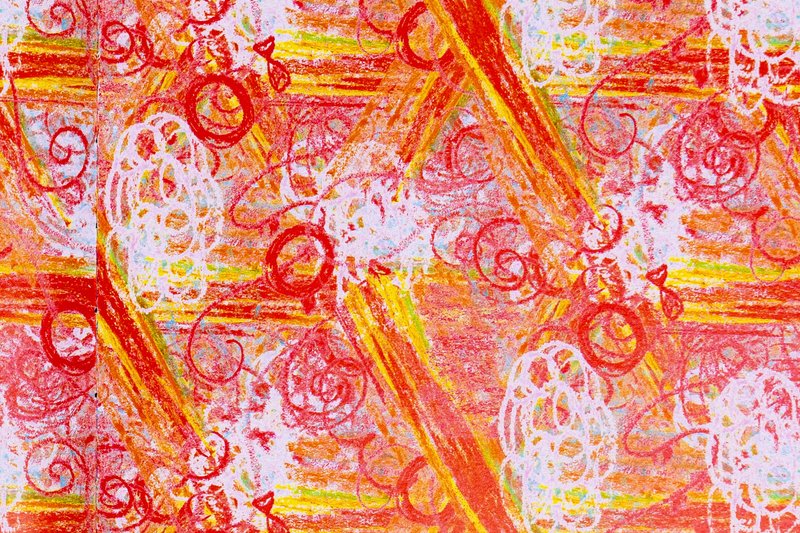
The students were given a cone with 3 yards of yarn. This sewing machine yarn represents a line. The students were asked to draw with this line and create letters. A session of uncontrolled experimentation followed. Some people got frustrated because the material was not behaving the way they expected, others got lost in labour intensive try outs. The design process was speeded up by demanding quantity over quality. The students produces a rich collection of specimens, failures, surprises and typographic inventions. Quality surfaced by looking at the possibilities of the results, not the results themselves. Students were given more time to concentrate and dig deeper for more options of a single experiment. They were asked to create a systematic sequence to expand their type treatment into a series of results. How can you make a system grow? Students seemed to be relieved when they were asked to translate their experiment in the computer. How do you Adobe Illustrator or Photoshop behave when you are wishing for a type treatment that includes gravity, three-dimensionality, texture or something else you witnessed while working with analogue material? This workshop turned out to be a research on how an analogue reference can make you look for a different way to work digitally. Type was a platform for introducing them to an alternative design process.

Workshop (2013) with Hansje van Halem

The students were given a cone with 3 yards of yarn. This sewing machine yarn represents a line. The students were asked to draw with this line and create letters. A session of uncontrolled experimentation followed. Some people got frustrated because the material was not behaving the way they expected, others got lost in labour intensive try outs. The design process was speeded up by demanding quantity over quality. The students produces a rich collection of specimens, failures, surprises and typographic inventions. Quality surfaced by looking at the possibilities of the results, not the results themselves. Students were given more time to concentrate and dig deeper for more options of a single experiment. They were asked to create a systematic sequence to expand their type treatment into a series of results. How can you make a system grow?

Students seemed to be relieved when they were asked to translate their experiment in the computer. How do you Adobe Illustrator or Photoshop behave when you are wishing for a type treatment that includes gravity, three-dimensionality, texture or something else you witnessed while working with analogue material?

This workshop turned out to be a research on how an analogue reference can make you look for a different way to work digitally. Type was a platform for introducing them to an alternative design process.

HANSJE_VAN_HALEM_112mod.jpg
HANSJE_VAN_HALEM_115mod.jpg
HANSJE_VAN_HALEM_131mod.jpg
HANSJE_VAN_HALEM_099.jpg

Projets similaires

ECAL Light House

BA GRAPHIC DESIGN

BA MEDIA & INTERACTION DESIGN

BA PHOTOGRAPHY

ECAL Light House

with Jean-Vincent Simonet, Léonard Guyot, Florian Pittet (Sigmasix), Vincent Jacquier, Julien Gurtner

During a week of collaborative work, first-year students in the Visual Communication department at ECAL were given the ambitious task of creating a complete audiovisual experience, designing a light and sound architecture based solely on five original musical compositions. Using a central totem-like screen installation and projections on the surrounding walls, enhanced with lasers, they created a visual environment, broadcast in real time, which was presented as a performance to the public at the end of the week. The aim was to construct a universe capable of fully utilizing the space and the various stage elements, inviting the audience to move around and experience the live performance in its entirety. Five cross-functional creative groups, each with a different sound base, were supervised by Jean-Vincent Simonet and Léonard Guyot to produce images and test them throughout the week on the device, which was developed, set up and operated by a sixth group under the supervision of Florian Pittet, Matthieu Minguet and Achille Masson.

Type Design  BA2 – S1 2025

BA GRAPHIC DESIGN

Type Design BA2 – S1 2025

with Aurèle Sack

Second-year students were required to manually develop the lowercase letters of two typefaces.

Visual Identity – BA2 S1 2025

BA GRAPHIC DESIGN

Visual Identity – BA2 S1 2025

with Adeline Mollard

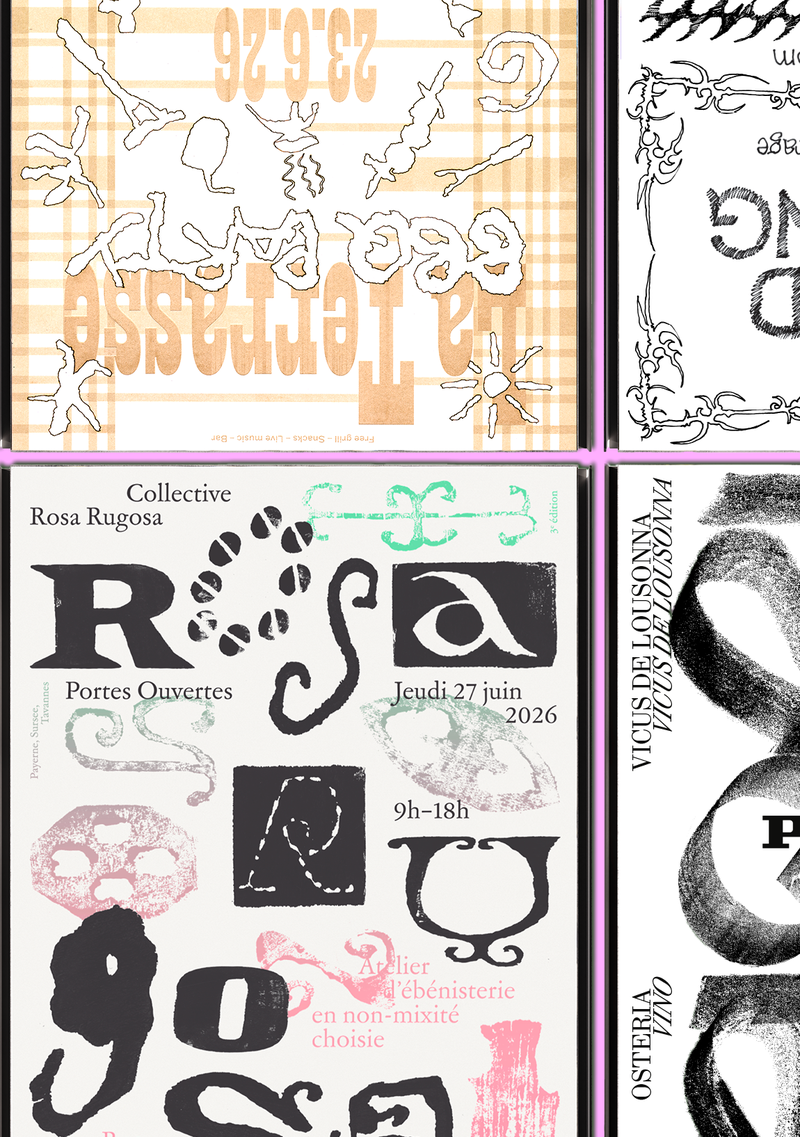
As part of the visual identity course led by Adeline Mollard, students developed a visual identity starting from a randomly selected business card. By appropriating one of its graphic elements and its title, each project offers a unique interpretation. The identity is then expanded across a range of formats, from business cards to F4 posters, including posters, flyers, business cards, and an animated poster.

Editorial Design – BA2 S1 2025

BA GRAPHIC DESIGN

Editorial Design – BA2 S1 2025

with Diego Bontognali

As part of this editorial design course, students developed a research-based project focused on the selection and design of texts around a shared theme. Based on a curated set of sources, each project presents two editions with identical content, produced in both a large and a small format.

Contextual Design – BA2 S1 2025

BA GRAPHIC DESIGN

Contextual Design – BA2 S1 2025

with Nicole Udry

Genius Loci, or the spirit of the place, refers to the unique identity or essence of a location. In architecture, this principle suggests that the specific characteristics of a place should be reflected and extended in a design. In the case of the second-year graphic design students, they have applied this principle to communication projects focused on promoting or extending the identity of a particular place through design. Their work likely explores how to visually capture and communicate the essence of a space, using graphic design elements that resonate with the architectural features or history of the place.
Related courses