Burns

Mélanie Rappo – Burns

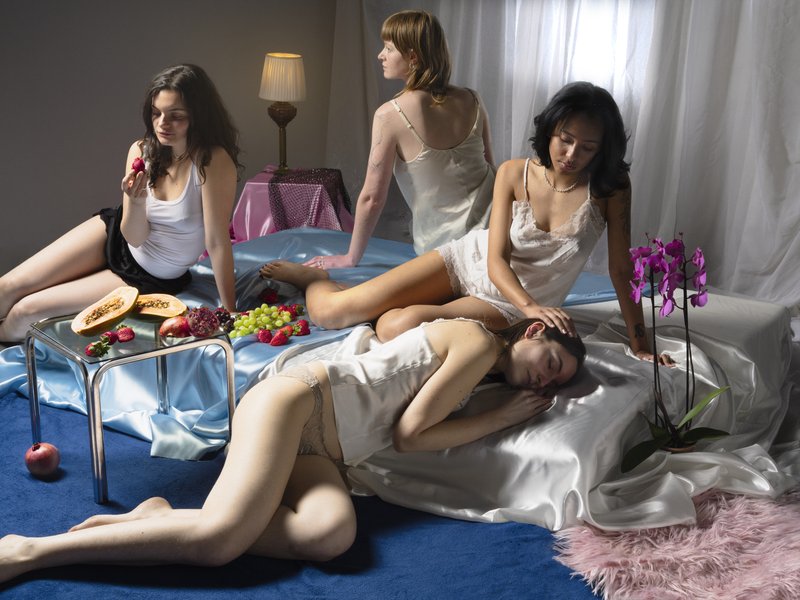
Juliette lives in a small country town. The eighteen year old adolescent is about celebrate their three and a half year anniversary with her boyfriend.  Her hopes of a perfect date are shattered and make way for a violent break up.

Diploma project (2013) by Mélanie Rappo

Know-how
Fiction

Fiction / 16min

Synopsis

Juliette lives in a small country town. The eighteen year old adolescent is about celebrate her "three and half year" anniversary with her boyfriend. Her hopes of a perfect date are shattered and make way for a violent break up.

Commentaire

Melanie's film resembles her and that surely is what attaches me to it in the first place. It's so devious the way movies make you discover who you are, who you thought you weren't and ultimately who you would like to be. Melanie is a discreet and stubborn woman, secretive and proud, shy and intense. It's hard to know where she's taking you, but she holds your hand. Burns tells in its own way the dark side of the love relationship when you are a girl who is not "obvious" and that you would like to love normally, bourgeoisly. The heroine is a princess; she lives in a castle with a pet except that everything is messed up: the dog runs away and the mother says slimy and disgusting things with her mouth. The princess loves a prince, but he is also a mess: he says disgusting things with his slimy mouth, but he kisses so well. The beauty of the film - and its difficult bet - is not to explain much and especially not to link, for example, the death of a hedgehog and the undressing, a knife on the skin and the word caress instead of the word blow. And we remain locked up like the princess in the dungeon of love.

Hippolyte Girardot / Actor, director

Projects related to Fiction

Création cinématographique– 2026

BA PHOTOGRAPHY

Création cinématographique– 2026

with Orsola Valenti

Off-camera By exploring what lies outside the frame, students develop a sensitive and reflective approach to audiovisual creation. Throughout the semester, students are encouraged to reflect on the political and formal issues surrounding the moving image, as well as the relationship between the visible and the invisible. 

Film Production – 2026

BA PHOTOGRAPHY

Film Production – 2026

with Julien Bourdeille

Événement Lumineux Through an in-depth exploration of light as a narrative and sensory medium, first-year students created a short film on the theme “Luminous Event.” This project allows them to learn how to manage a complete audiovisual project while mastering the tools of filming, framing, and camera movement.  

Staged Photography – 2026

BA PHOTOGRAPHY

Staged Photography – 2026

with Charlotte Krieger

Unseen This course introduces students to the creation of a seven-image series built around the theme Unseen. They will learn to combine set design, characters, and lighting to produce strong, coherent staged images. Through a practical and technical approach, the course develops their ability to conceive and manage a complete photographic project, direct models, work with natural and artificial light, and collaborate under conditions similar to professional editorial or commercial shoots. Students will refine their photographic vision while preparing for the creative and technical demands of the industry.

Last Minute Risk

BA PHOTOGRAPHY

Last Minute Risk

with Natacha Lesueur

“What is clearly conceived can be clearly expressed, and the words to say it come easily.” Nicholas Boileau, *L’art poétique*. As students embark on their final year of study at ECAL, with their interests and methods taking shape, this final project offers an opportunity to challenge their own rules, established practices and influences, to refuse to settle for the status quo and to take risks.

ECAL X MHL – Photosensible

BA PHOTOGRAPHY

ECAL X MHL – Photosensible

with Philippe Jarrigeon

Drawing inspiration from the 19th-century archives of photographer André Schmid, second-year Bachelor’s students collaborated with the Lausanne History Museum to create an inspiring dialogue between the past and the present. For most of the students, his name was unfamiliar. Discovering his work, preserved in the collections of the Lausanne History Museum, opened up a field of exploration that was both historical and artistic. Through André Schmid’s images, a foundational chapter in Swiss photography was revealed to them. Through an immersion in the archives, they were invited to engage in a dialogue with this pioneering practice—not to cite or reproduce it, but to reimagine it, question it, and interpret it, thereby creating a tension between the origins of photography and its most contemporary developments.

Related courses