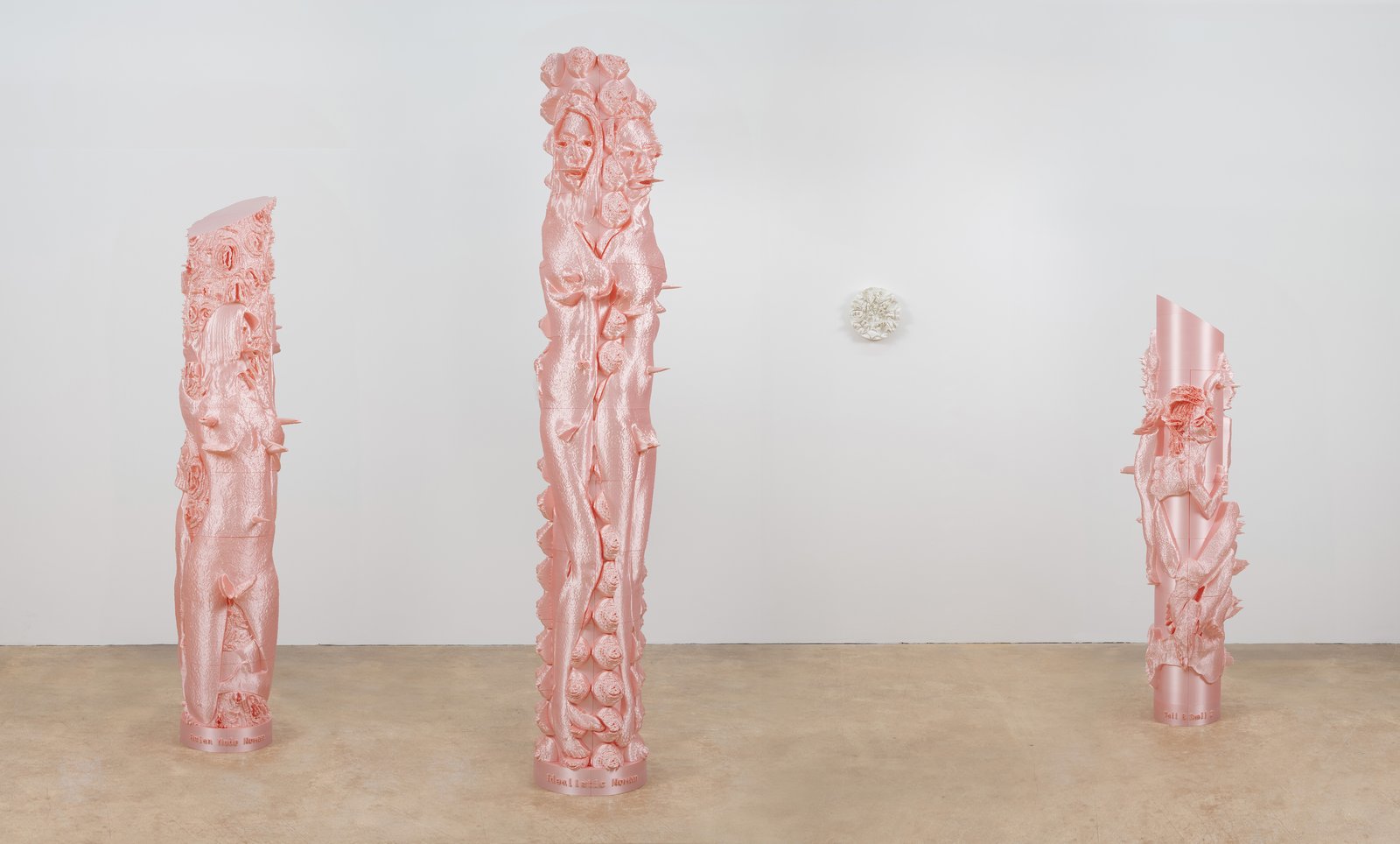
Pretty in Pink

Francesca Bergamini – Pretty in Pink

When male desire turns into violence, it often begins with the objectification of the female body. Pretty in Pink reclaims those bodies: low-res thumbnails of 3D nude female models—created by male designers for digital porn, idealized and passive—are altered using the same 3D tools that shaped them. The curves stop seducing. They become hostile, almost threatening. 3D-printed at life-size, these figures stand like anti-monuments, exposing outdated power. Installed as a narrative path, from glossy pink columns to a white-on-white final piece, the viewer moves through stages of desire, distortion, and fear. What was once virtually consumed by the male gaze now returns with physical weight, uncensored presence, and resistance.

Diploma project (2025)

Students
Francesca Bergamini
ECAL/Francesca Bergamini

1/3

2025_S4_MAP2_Francesca-Bergamini_Diploma_PreattyInPink_Documentation-2 copy.jpg
ECAL/Francesca Bergamini
Pretty in Pink_ECAL_Francesca Bergamini_11.jpg
Pretty in Pink_ECAL_Francesca Bergamini_10.jpg
Pretty in Pink_ECAL_Francesca Bergamini_03.jpg
Pretty in Pink_ECAL_Francesca Bergamini_04.jpg
Pretty in Pink_ECAL_Francesca Bergamini_19.jpg
Pretty in Pink_ECAL_Francesca Bergamini_12.jpg
Pretty in Pink_ECAL_Francesca Bergamini_20.jpg
Pretty in Pink_ECAL_Francesca Bergamini_23.jpg

Projets similaires

WORKSHOP - CGI WITH AREA OF WORK – 2025

MA PHOTOGRAPHY

WORKSHOP - CGI WITH AREA OF WORK – 2025

with Area Of Work

The Computer-Generated Imagery (CGI) Workshop is an introduction to 3D creation software that allows you to create images with photographic qualities that are not photographs.  This workshop centers on the theme of “Minimal,” inviting students to explore the creative and technical foundations of contemporary CGI image-making.  It emphasizes materiality and the expressive impact of reduction. Every form, light, and texture has a specific role, negative space guides the emotional tone, and fine details unify the composition.

ECAL x PAPERBOY

MA PHOTOGRAPHY

ECAL x PAPERBOY

with Charles Negre, Milo Keller, Clément Lambelet, Tanguy Morvan

Paperboy ECAL is the result of a close collaboration between Paperboy Magazine and first-year students of the Master Photography program. Under the guidance of photographer Charles Negre , they explored the potential of everyday objects to create mysterious and playful still lives. 

ECAL at OFFPRINT Paris 2025

MA PHOTOGRAPHY

ECAL at OFFPRINT Paris 2025

with Bruno Ceschel, Nicolas Polli, Milo Keller, Clément Lambelet

During Paris Photo 2025, ECAL will present a selection of its books at OFFPRINT Paris. ECAL Master Photography is pleased to present a selection of books created by its second-year students. This event offers an opportunity to engage live with the young photographers, exploring the origins of their projects and the stories behind each of these publications.

Daniel Martinez – A River Has No Shore

MA PHOTOGRAPHY

Daniel Martinez – A River Has No Shore

by Daniel Martinez

Flowing from an Alpine glacier to the Mediterranean Sea, the Rhône River runs through ice caves, forests, cities and industrial sites. It sustains ecosystems, defines geographies and connects cultures across space and time. However, the boundless flux of the world’s waters today faces increasing stories of tragedy and collapse. Climate change doesn’t manifest only on a material level but also overwhelms the emotional dimension of human life. Today, the psychological toll of environmental crisis amplifies states of eco-anxiety and solastalgia, triggered by lived experiences, mediated imagery and narratives of apocalyptic breakdown. A River Has No Shore reflects on the distress caused by climate change and its representation by looking at the water along the Rhône River in its endless forms.

Doyoung Kim – Flattened Roughness

MA PHOTOGRAPHY

Doyoung Kim – Flattened Roughness

by Doyoung Kim

The work Flattened Roughness explores war image consumption and resulting guilt. The photographer collects and prints images of death then lick and absorb them physically, confronting the emotional and physical distance created by media. Suicide drones’ cameras constantly calculate distance to humans for destruction. In this process, the distance between humans is forgotten. To overcome this distance, he brings the images into my body. This act, where intimacy and brutality coexist, transforms voyeurism into mourning and care, confronting my lost humanity. Through sensory performance, he bridges the gap between himself and mediated death, exploring the clash of dulled emotion and sensation. This confessional, physically exhausting work explores alternative sensory approaches for the recovery of broken humanity.

Related courses