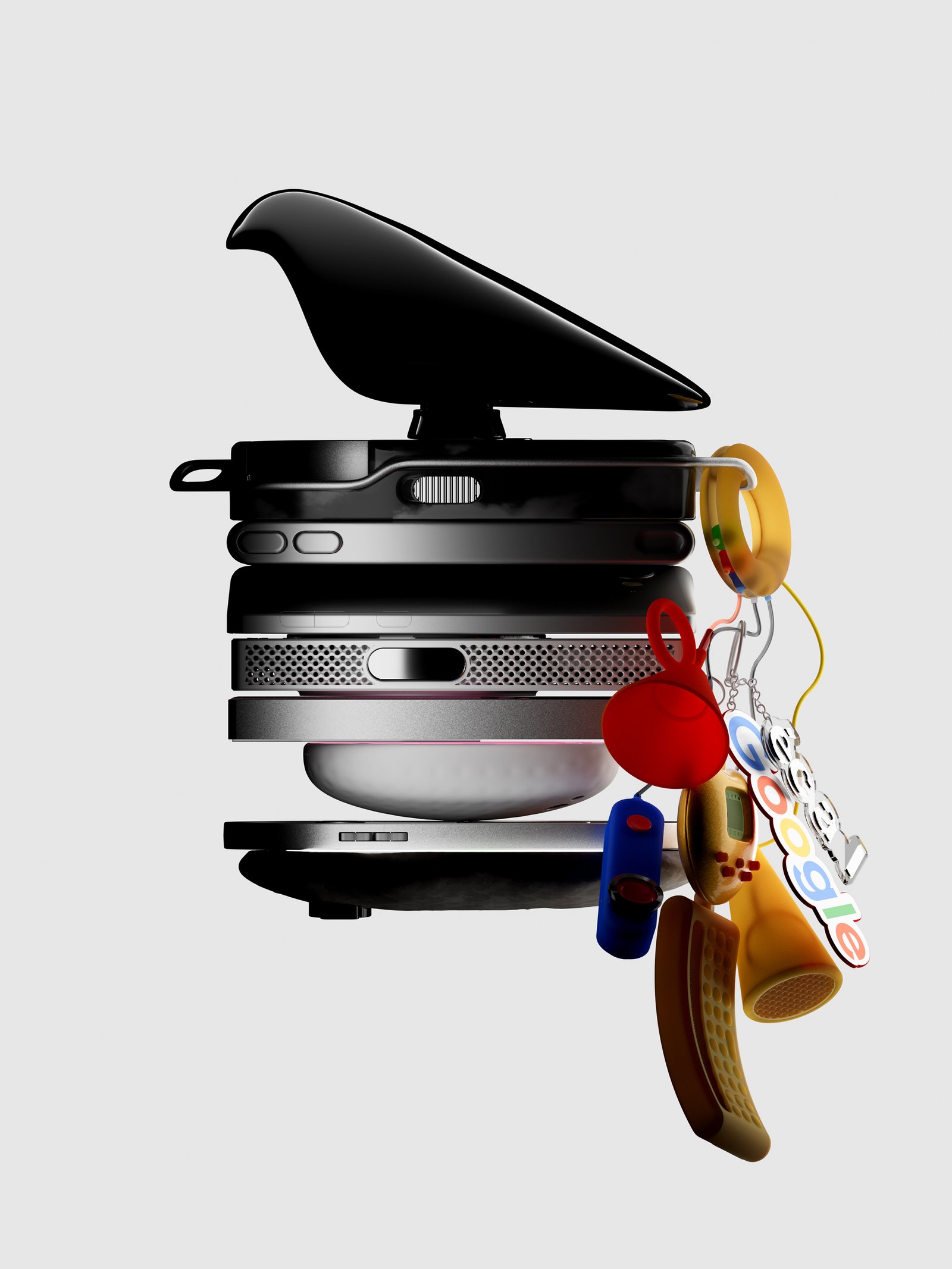
ECAL X GOOGLE - A Message From Tomorrow

ECAL X GOOGLE - A Message From Tomorrow

The Industrial Design team at Google (Google ID) initiated a collaboration with ECAL/University of Art and Design Lausanne to develop a concept for a mobile-focused product inspired by a daily ritual.

ECAL’s Master Product Design students were invited to envision innovative hardware engaging with contemporary habits. Through compelling storytelling, these conceptual projects consider the human dimension of mobile technology: how it shapes everyday gestures and how our relationships with devices might evolve in the future.

This collaboration reflects ECAL’s forward-looking approach to design, combining experimentation, critical thinking, and a strong receptivity to emerging technologies.

Collaboration (2026) with Chris Kabel

Assistants
Yohanna Rieckhoff
Students
Hugo Von Hofsten, Gyuhan Park, Xose Lois Piñeira, Gunnar Kähler, Motong Yang, Paul Quentin, Ehrat Lee, Moritz Engel, Julia Siebert Cáceres, Finn Johnson
PRESS KIT

260414_JD_ECAL_Google_0128_highres_blue_online.jpg

THE FINGER PHONE


By Hugo Von Hofsten

The Finger Phone questions the limits of today’s phone form factors. Starting from the frustration that phones must always be held, it prioritises secondary hardware functions. The device shifts from distraction to tool. An animated finger extends from the side, carrying a camera, light and touchpad to assist in small everyday moments. The Finger Phone can stand on its own and brighten its surroundings, not only its screen.


Robin


by Gyuhan Park

Robin is a mobile device designed to move beyond flat, passive screens. Inspired by pet-bird behaviors, it communicates like a companion rather than a voice assistant. Its eyes are cameras, its beak functions as sensor and speaker, and its body becomes an organic display for touch and glance-based interaction. Robin can joke, tease or sulk. It’s built to read your condition quickly and respond when you seem stressed or unwell. It also handles the practical tasks, messages, planning, and daily tasks – in a way that is more lively and enjoyable.

260414_JD_ECAL_Google_0317_highres_blue_online.jpg

1/2

SOUND MACHINE


by Xose Lois Piñeira

Inspired by microphones and speakers, Sound Machine reimagines the phone around voice rather than the screen. Its 3D-printed aluminium lattice body is acoustically transparent, letting sound move freely while structuring a layered assembly. Components sit within the mesh, each layer defined by its function. A small round screen handles essential confirmations. A contact transducer on the back transmits sound through surfaces or the body when worn against the sternum. Sound Machine can rest, hang, or be carried while still listening and speaking.


Everydaycarry


by Motong Yang

EveryDayCarry critiques the smartphone as a standardised, closed entity that contains everything yet expresses little. While phones have become essential digital toolkits, app-based interfaces reduce tactile interaction and obscure intention through endless options. EveryDayCarry proposes a device that adapts to daily activities, while its character continues to reflect the identity of the person who carries it.

260414_JD_ECAL_Google_0472_highres_blue_online.jpg

1/2

Totem


by Paul Quentin

Totem revisits the smartphone’s integrated functions. While many tools have been absorbed into the phone, they remain constrained by the rigid “slab” form factor. This project reshapes the device into a wedge so it can function as a discreet tabletop object. Resting on its side, Totem supports video calls, media viewing or AI assistance. When laid flat, its edge becomes a subtle notification interface.


LIMINAL FRAME


by Ehrat Lee

Liminal Frame is a phone designed to blend into the physical world. A four-layer display gives physical depth to digital content: opaque when needed, transparent when interacting with surroundings. It enables spatial computing without wearables. You can look through the phone, pin information in space, and return to it later. Timetables, notes or cues appear only when needed, turning the phone into a window on the world, rather than a screen to look at.

260414_JD_ECAL_Google_0425_highres_blue_online.jpg

1/2

rove


by Moritz Engel

Rove is the ultimate tool for remote wilderness, designed to redefine our relationship with power. This off-grid smartphone features a pull-cord system: one minute of pulling spins a flywheel to generate twenty minutes of battery life via an axial flux generator. The Dyneema cord doubles as a versatile carrying strap, while the spool integrates a tactile control wheel. Built from anodised aluminum with glove-friendly buttons and a recycled polycarbonate shell, Rove combines durability with total energy independence.


Dyno


by Julia Siebert Cáceres

Dyno is a phone that never runs out of power it constantly charges itself. Free from plugs, it’s designed to stay mobile in everyday life: a full workday, a late-night walk home, a power outage. At its core, a hybrid charging system converts body movement into energy through electromagnetic induction. A visible rotor with a multipolar magnet captures motion from multiple directions, spinning over a copper coil to induce electricity. This passive process generates around 25-30% of the battery per day and can be accelerated by shaking.

1/2


260414_JD_ECAL_Google_0581_highres_blue_online.jpg

GRID


by Finn Johnson

GRID is a haptic communication device that replaces visual stimuli with fields of touch. Its surface contains an array of tactile pixels forming a language that is felt rather than read. Information arrives as pressure, rhythm, and duration, engaging the body directly. Between screen and skin, GRID proposes a paradigm where communication becomes part of the body.


stone phone


 by Gunnar Kähler

When we pick up a stone on a beach or by a riverbank, we instinctively choose the one whose shape feels comfortable to hold. Stone Phone draws inspiration from this gesture by blurring the line between an archaic tool and the sophisticated everyday device that the smartphone has become. Challenging industrial uniformity, this project envisions phones in an infinitely varied range of shapes. Each Stone Phone would be chosen by the user based on the shape and texture that feels pleasant to the touch.

1/2

Images Jasmine Deporta, Animations Tanguy Morvan

Projets similaires

Omar Bassil – Esplanade

MA PRODUCT DESIGN

Omar Bassil – Esplanade

by Omar Bassil

Esplanade is an exploration of how a flat-cut piece of leather can be transformed into a slip-on shoe through folding, wrapping, gathering, and minimal joining using simple tools. Stripping leather shoemaking down to its essentials, form emerges through tension and wear. Referencing the carbatina, a Roman shoe typology constructed from a single piece of leather, the design adapts its pattern principle to a contemporary slip-on. While the construction is reduced to a few essential operations, the making process still relies on the expertise of leather workers and techniques specific to their craft. This approach yields a simple, relaxed, and enduring object as a reflection on craftsmanship and material honesty.

Ehrat Lee – Lightworks

MA PRODUCT DESIGN

Ehrat Lee – Lightworks

by Ehrat Lee

Lightworks is a lighting system that gives images a fixed place in the home. Photographs, graphics and drawings are saved constantly but mostly stay hidden on phones, in books or in drawers. Built around existing industrial processes, a single UV-printed sheet of paper forms the curved shade, held by a lightweight aluminium structure and fixed with magnets. The lamp disassembles flat and ships inside its own print tube, the image rolled within. Available in three sizes, it turns each print into an illuminated object. Prints can be exchanged in seconds, from personal images to commissioned work.

Moritz Engel – CALYX

MA PRODUCT DESIGN

Moritz Engel – CALYX

by Moritz Engel

CALYX is a minimalist climbing sandal. Designed for optimal hygiene and maintenance, it reduces the conventional mixed-material, climbing shoe to a textile-free exoskeleton. It is built around a durable rubber core with replaceable, wear-indicating Vibram soles and features "Debond-on-Demand" adhesive, which allows for resoling during use and separation for downcycling at the end of its life. While the sticky climbing shoe rubber soles provide the usual performance, a secure and adjustable fit is made possible by easily interchangeable laces. Thanks to its foldable and packable design, CALYX is ideal for the purist climber who strives for maximum feel and feedback with minimum weight.

Carl Johan Jacobsen – Vaev

MA PRODUCT DESIGN

Carl Johan Jacobsen – Vaev

by Carl Johan Jacobsen

Vaev is chair made from a simple rigid frame that supports a custom made net. Normally used for fences, this net becomes a seat providing comfort while maintaining a light and open expression. The combination of these elements creates a chair that feels visually light yet structurally defined, allowing light, air and rain to pass freely through it. Durable enough for outdoor use and subtle enough for interior spaces.

Carolien Janssens – Alpen

MA PRODUCT DESIGN

Carolien Janssens – Alpen

by Carolien Janssens

Alpen is a trail running vest designed for runners with breasts. A trail running vest is a lightweight garment used to carry water, nutrition, and equipment during mountain runs while fitting tightly against the body. However, current products continue to be engineered with a single body type in mind: a relatively flat torso. Even women's models remain a shrunk version of men's products, causing pressure points across the bust. This project starts from a feminine body geometry. Conceived by experimentation with paper modelling and the 3D pattern-making software CLO, Alpen offers a volume-creating front panel, a dual closure system that allows independent adjustment above and below the bust, and a dual sizing system combining torso size and bust volume, similar to bra sizing.

Related courses