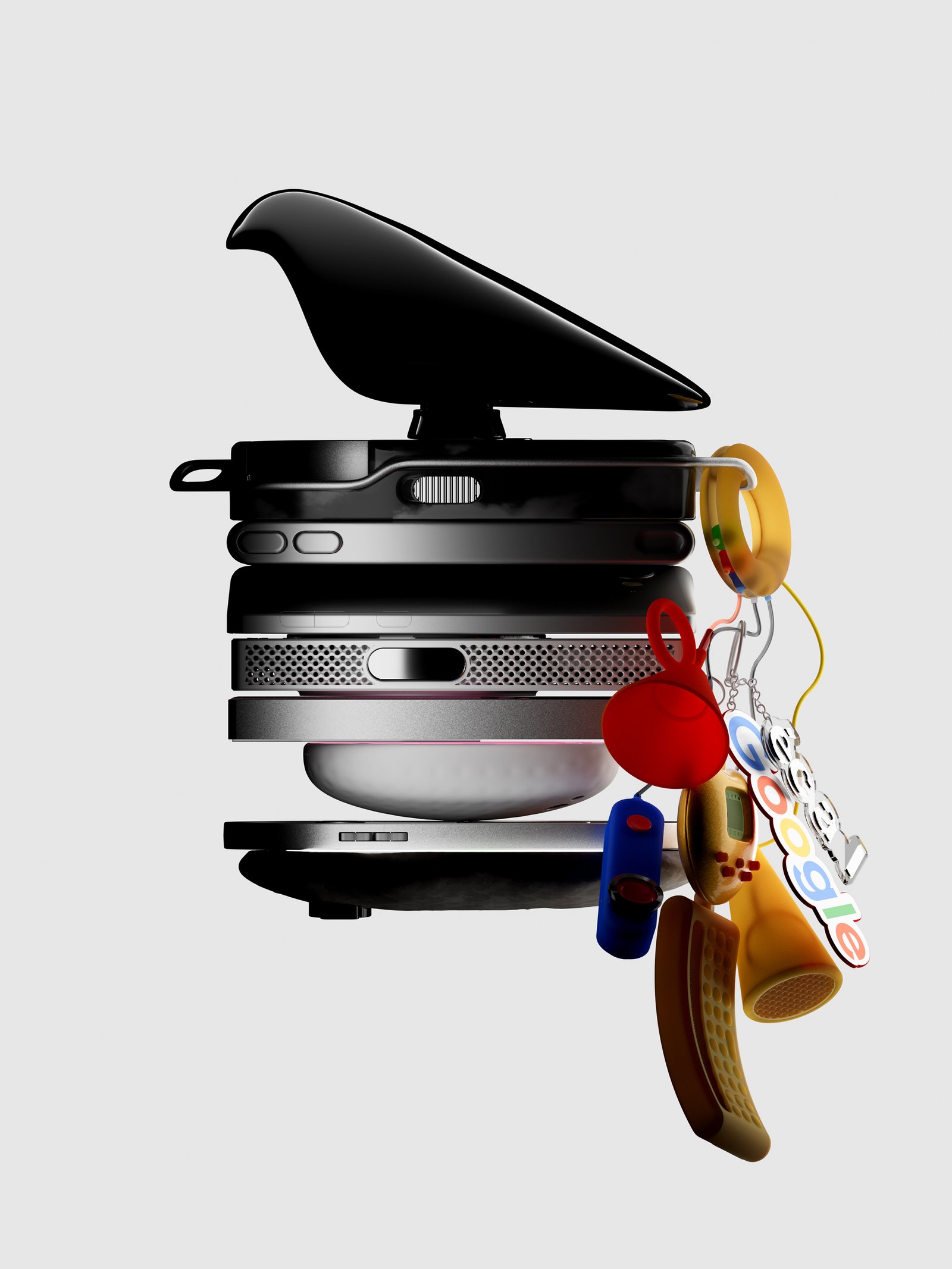
ECAL X GOOGLE - A Message From Tomorrow

ECAL X GOOGLE - A Message From Tomorrow

The Industrial Design team at Google (Google ID) initiated a collaboration with ECAL/University of Art and Design Lausanne to develop a concept for a mobile-focused product inspired by a daily ritual.

ECAL’s Master Product Design students were invited to envision innovative hardware engaging with contemporary habits. Through compelling storytelling, these conceptual projects consider the human dimension of mobile technology: how it shapes everyday gestures and how our relationships with devices might evolve in the future.

This collaboration reflects ECAL’s forward-looking approach to design, combining experimentation, critical thinking, and a strong receptivity to emerging technologies.

Collaboration (2026) with Chris Kabel

Assistants
Yohanna Rieckhoff
Students
Hugo Von Hofsten, Gyuhan Park, Xose Lois Piñeira, Gunnar Kähler, Motong Yang, Paul Quentin, Ehrat Lee, Moritz Engel, Julia Siebert Cáceres, Finn Johnson
PRESS KIT

260414_JD_ECAL_Google_0128_highres_blue_online.jpg

THE FINGER PHONE


By Hugo Von Hofsten
Animation by Tanguy Morvan
Photography by Jasmine Deporta

The Finger Phone questions the limits of today’s phone form factors. Starting from the frustration that phones must always be held, it prioritises secondary hardware functions. The device shifts from distraction to tool. An animated finger extends from the side, carrying a camera, light and touchpad to assist in small everyday moments. The Finger Phone can stand on its own and brighten its surroundings, not only its screen.


Robin


by Gyuhan Park
Animation by Tanguy Morvan
​​​​​​​Photography by Jasmine Deporta

Robin is a mobile device designed to move beyond flat, passive screens. Inspired by pet-bird behaviors, it communicates like a companion rather than a voice assistant. Its eyes are cameras, its beak functions as sensor and speaker, and its body becomes an organic display for touch and glance-based interaction. Robin can joke, tease or sulk. It’s built to read your condition quickly and respond when you seem stressed or unwell. It also handles the practical tasks, messages, planning, and daily tasks – in a way that is more lively and enjoyable.

260414_JD_ECAL_Google_0317_highres_blue_online.jpg

1/2

SOUND MACHINE


by Xose Lois Piñeira
Animation by Tanguy Morvan
​​​​​​​Photography by Jasmine Deporta

Inspired by microphones and speakers, Sound Machine reimagines the phone around voice rather than the screen. Its 3D-printed aluminium lattice body is acoustically transparent, letting sound move freely while structuring a layered assembly. Components sit within the mesh, each layer defined by its function. A small round screen handles essential confirmations. A contact transducer on the back transmits sound through surfaces or the body when worn against the sternum. Sound Machine can rest, hang, or be carried while still listening and speaking.


Everydaycarry


by Motong Yang
Animation by Tanguy Morvan
​​​​​​​Photography by Jasmine Deporta

EveryDayCarry critiques the smartphone as a standardised, closed entity that contains everything yet expresses little. While phones have become essential digital toolkits, app-based interfaces reduce tactile interaction and obscure intention through endless options. EveryDayCarry proposes a device that adapts to daily activities, while its character continues to reflect the identity of the person who carries it.

260414_JD_ECAL_Google_0472_highres_blue_online.jpg

1/2

Totem


by Paul Quentin
Animation by Tanguy Morvan
Photography by Jasmine Deporta​​​​​​​

Totem revisits the smartphone’s integrated functions. While many tools have been absorbed into the phone, they remain constrained by the rigid “slab” form factor. This project reshapes the device into a wedge so it can function as a discreet tabletop object. Resting on its side, Totem supports video calls, media viewing or AI assistance. When laid flat, its edge becomes a subtle notification interface.


LIMINAL FRAME


by Ehrat Lee
Animation by Tanguy Morvan
​​​​​​​Photography by Jasmine Deporta

Liminal Frame is a phone designed to blend into the physical world. A four-layer display gives physical depth to digital content: opaque when needed, transparent when interacting with surroundings. It enables spatial computing without wearables. You can look through the phone, pin information in space, and return to it later. Timetables, notes or cues appear only when needed, turning the phone into a window on the world, rather than a screen to look at.

260414_JD_ECAL_Google_0425_highres_blue_online.jpg

1/2

rove


by Moritz Engel
Animation by Tanguy Morvan
​​​​​​​Photography by Jasmine Deporta

Rove is the ultimate tool for remote wilderness, designed to redefine our relationship with power. This off-grid smartphone features a pull-cord system: one minute of pulling spins a flywheel to generate twenty minutes of battery life via an axial flux generator. The Dyneema cord doubles as a versatile carrying strap, while the spool integrates a tactile control wheel. Built from anodised aluminum with glove-friendly buttons and a recycled polycarbonate shell, Rove combines durability with total energy independence.


Dyno


by Julia Siebert Cáceres
Animation by Tanguy Morvan
Photography by Jasmine Deporta​​​​​​​

Dyno is a phone that never runs out of power it constantly charges itself. Free from plugs, it’s designed to stay mobile in everyday life: a full workday, a late-night walk home, a power outage. At its core, a hybrid charging system converts body movement into energy through electromagnetic induction. A visible rotor with a multipolar magnet captures motion from multiple directions, spinning over a copper coil to induce electricity. This passive process generates around 25-30% of the battery per day and can be accelerated by shaking.

1/2


260414_JD_ECAL_Google_0581_highres_blue_online.jpg


GRID


by Finn Johnson
Animation by Tanguy Morvan
​​​​​​​Photography by Jasmine Deporta

GRID is a haptic communication device that replaces visual stimuli with fields of touch. Its surface contains an array of tactile pixels forming a language that is felt rather than read. Information arrives as pressure, rhythm, and duration, engaging the body directly. Between screen and skin, GRID proposes a paradigm where communication becomes part of the body.


stone phone


 by Gunnar Kähler
Animation by Tanguy Morvan
​​​​​​​Photography by Jasmine Deporta

When we pick up a stone on a beach or by a riverbank, we instinctively choose the one whose shape feels comfortable to hold. Stone Phone draws inspiration from this gesture by blurring the line between an archaic tool and the sophisticated everyday device that the smartphone has become. Challenging industrial uniformity, this project envisions phones in an infinitely varied range of shapes. Each Stone Phone would be chosen by the user based on the shape and texture that feels pleasant to the touch.

1/2

Images Jasmine Deporta, Animations Tanguy Morvan

Projets similaires

Adam Friedrich – Airy

MA PRODUCT DESIGN

Adam Friedrich – Airy

by Adam Friedrich

Airy is a research project that explores the use of air as a primary resource. It uses inflatable structures to protect valuable devices during travel. The design employs contemporary materials and pays particular attention to detail to offer relevant, everyday solutions for safeguarding increasingly fragile and valuable electronic devices.

Alicia Stricker – Stricker

MA PRODUCT DESIGN

Alicia Stricker – Stricker

by Alicia Stricker

Folly approaches the craft of beaded embroidery from a product design perspective. It explores the value of tactility above the visual aspects that the technique is traditionally valued for. Consequently, the project manifested as something that is experienced by the body - a sofa. Scaling up the traditionally small beads and applying principles of beaded embroidery in the development of a textile sofa cover allowed for the sofa to transcend its classic typology, creating a three-dimensional surface with a biological sculptural presence - an object that breaks the mould of what we expect of something as familiar as a sofa and begs to be experienced through touch.

Brice Tempier – Péninsule

MA PRODUCT DESIGN

Brice Tempier – Péninsule

by Brice Tempier

  In a context where domestic space is being reduced and reconfigured, living sometimes becomes a temporary act. Places are passed through rather than settled in, and the question is no longer so much one of layout as of presence. Inspired by the archetype of the mezzanine, Péninsule takes the form of a mobile structure the size of a bed. Set within a room, it acts as a habitable frame, delimited without being enclosed, introducing domestic depth where there was previously only an available surface. Conceived as a place of rest, retreat, and appropriation, it combines a bed, a daybed, and a folding desk, as well as mobile elements such as shelves, hooks, and curtains, modulating light, movement, and presence. Without offering formal modularity, the object provides an open support for everyday uses and movements. Péninsule is thus defined less by what it can be transformed into than by the way it is used.  

Carl Johan Jacobsen – Hardwear

MA PRODUCT DESIGN

Carl Johan Jacobsen – Hardwear

by Carl Johan Jacobsen

In the U.K new court ruling threatens trans-people while the US government is doing a full assault on trans and female bodies. Hardwear is a collection of wearable objects offering a sense of protection in urban environments, as a response to a growing tendency of hostility towards the body. Hard surfaces become flexible armor, protective shields transform into high heels. Whether to preserve personal space on public transport or to create cognitive distance Hardwear aims to create a sense of security. By using hard materials, the feeling of being safe inside a car is transformed to the outside resulting in a line of wearable objects made for for everyday resistance. Drawn on protection typologies from sportswear, Hardwear is made of 100% recycled plastic with 3D printed elements.

Cedric Zimmerman – DUCTUS

MA PRODUCT DESIGN

Cedric Zimmerman – DUCTUS

by Cedric Zimmerman

DUCTUS is investigating how tangential fans can be reinterpreted in combination with spiral ducts, which are normally used in industrial HVAC systems, in a modular, energy-efficient ceiling ventilation system. The galvanised sheet metal is perforated locally using a specially developed laser manufacturing process and then processed into spiral ducts in an industrial standard procedure with almost no material loss. These ducts serve both as air ducts and as a supporting structure for the fan unit. The system, manufactured in collaboration with the Lausanne-based company Air Ventil, generates a wide, quiet air flow while also adding architectural accents.

Related courses