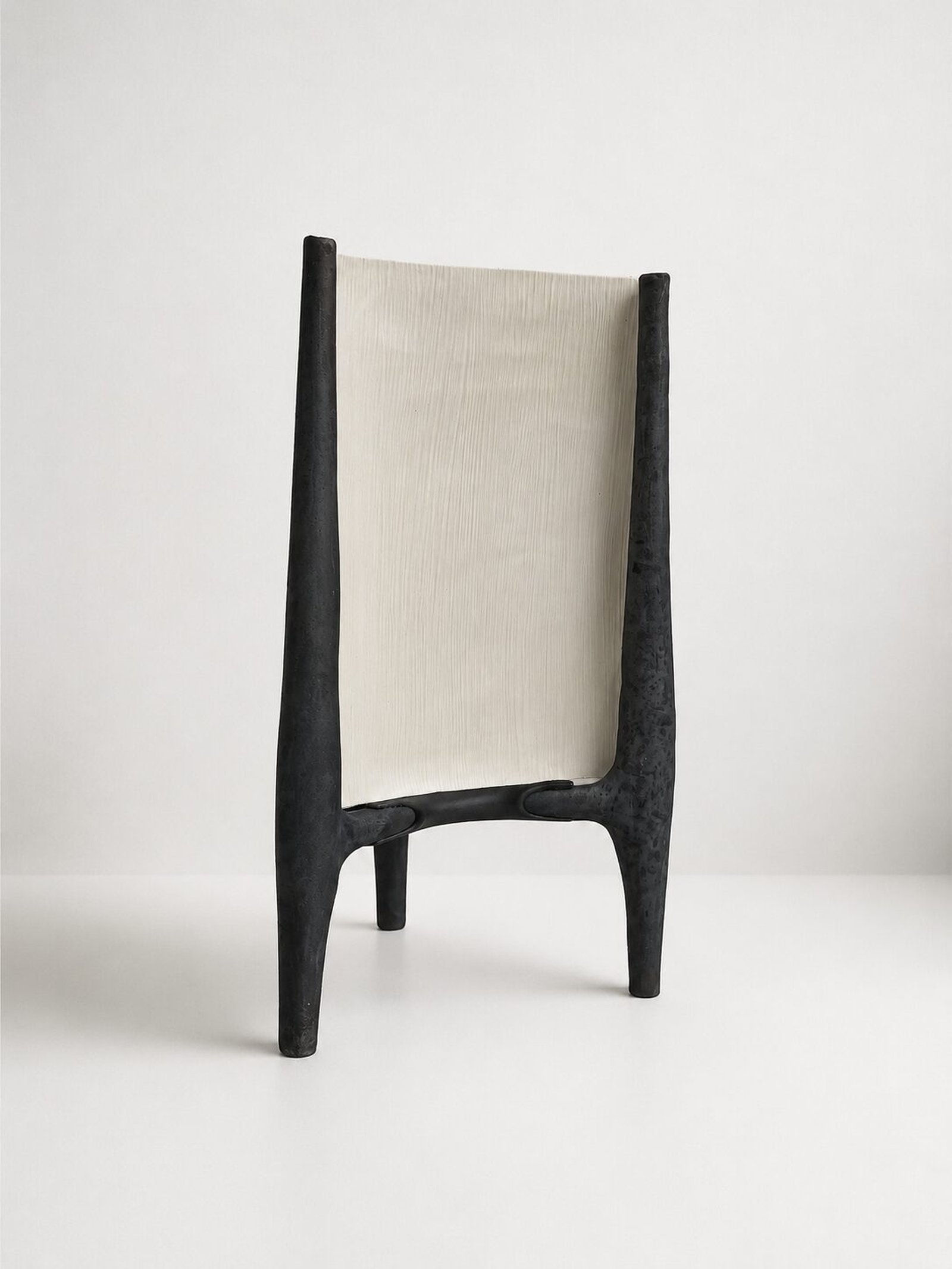
Lampe trois + 1

Maxime Billoud – Lampe trois + 1

Lampe trois + 1 is rooted in material research and innovation. At the intersection of craftsmanship and design, this ceramic and porcelain lamp reflects both the artisan's gesture and the designer's approach. It is composed of three identical legs connected by a central technical component, while molded porcelain panels are integrated into the structure. The smoked clay elements, inspired by the Japanese raku technique, contrast with the delicacy and translucency of porcelain. Designed as a flat-pack lamp that can be easily assembled, Lampe trois + 1 embodies a process of material exploration while resulting in a functional and tangible object.

Diploma project (2026)

Students
Maxime Billoud
Lampe trois +1_ECAL_Maxime Billoud 2_compressed.jpeg

Projets similaires

Seoho Ahn – Cascade

MAS DESIGN FOR LUXURY & CRAFTSMANSHIP

Seoho Ahn – Cascade

by Seoho Ahn

Jewellery is often seen as an ornamental object, yet it contains structural principles. A chain forms a continuous system of interconnected links that responds to gravity and distributes forces throughout its structure. Cascade explores how this logic can be translated from the body to space. When scaled up, the chain evolves from a decorative element into a load-bearing framework. Connections between links become structural joints, while the continuous flow of the chain becomes a path for transferring and balancing forces. Rather than borrowing the aesthetics of jewellery, Cascade translates its structural principles into a furniture system, transforming a decorative chain into an architectural structure.

Anna Andersson – LYSA

MAS DESIGN FOR LUXURY & CRAFTSMANSHIP

Anna Andersson – LYSA

by Anna Andersson

LYSA is a portable lamp designed for outdoor rituals and small everyday adventures. Inspired by the emotional connection we have to bags and objects made to be carried, the project explores how light can become something intimate and mobile. The lamp is intended for picnics, gardens, balconies, and walks in nearby nature, bringing a sense of warmth and domesticity outdoors. It features dimmable light, USB-C charging, and a protected charging port. The materials — cork, dark brown suede, and linen fabric — were chosen for their tactile and atmospheric qualities. LYSA explores fabric translucency, color tones, light diffusion, and stabilization techniques to create an object that feels soft, warm, and made to accompany quiet moments outdoors.

Thibaud Kanty Boto – ROHY

MAS DESIGN FOR LUXURY & CRAFTSMANSHIP

Thibaud Kanty Boto – ROHY

by Thibaud Kanty Boto

In Madagascar, rabane, a textile made from woven raffia fibers, has traditionally been used to make bags, mats, and everyday objects. Today, this weaving technique is gradually disappearing in favor of standardized production intended for export, particularly crochet-based work. Rooted in this evolving artisanal heritage, ROHY explores new possibilities for rabane. Through experimentation, by combining woven fibers with a binder and then molding them, this project reveals the structural and aesthetic potential of rabane. The collection proposes a contemporary reinterpretation of this ancestral craft through a series of accessories.

Martin Brouckaert – Brunch Service

MAS DESIGN FOR LUXURY & CRAFTSMANSHIP

Martin Brouckaert – Brunch Service

by Martin Brouckaert

Brunch Service is a modular collection of objects that transforms Sunday brunch into an architectural landscape. It consists of containers, utensils, and cutlery that, when stacked, create abstract graphic silhouettes. Based on tubular forms, the objective of this project is to break away from industrial standards through a twist that forms sculptural compositions. This system was designed to elevate the ritual of brunch, acting as a reinterpretation of modern silverware that serves as a celebration.

Alice Brovarone – Soft Hidden Gesture

MAS DESIGN FOR LUXURY & CRAFTSMANSHIP

Alice Brovarone – Soft Hidden Gesture

by Alice Brovarone

Soft Hidden Gesture is a stackable ceramic object composed of five elements. Assembled, they form a sculptural form inspired by the silhouette of a Japanese temple. Its true nature only emerges when it is taken apart: the object becomes a tea set. The contrast between exterior and interior colors reinforces this transition — the inside reveals a different color, visible only once the object is opened. Each element is designed digitally to ensure precise joints and formal continuity. The transition to ceramics introduces a fundamental tension, the material lives, shrinks, reacts. A further challenge is to develop a visual identity able to reflect the inner meaning of the project. The piece is intended in porcelain, a material whose delicacy suits the quiet character of the object.

Related courses