The Picture-Writer. Warja Lavater, Graphic Designer and Illustrator

The Picture-Writer. Warja Lavater, Graphic Designer and Illustrator

This project investigates the work of the graphic designer and artist, Warja Lavater, an internationally recognised Swiss graphic designer, illustrator, bookmaker, filmmaker and artist.

Research project (2025) with Jonas Berthod, Davide Fornari

Researcher
Carol Ribi
Image credit
Warja Lavater, Le Petit Chaperon Rouge. Talant (Côte-d'Or) : les Doigts qui rêvent. © Bibliothèque Méjanes, CC BY-SA 2.0
Know-how
Illustration, Editorial

Amongst Warja Lavater’s (Winterthur, 28 September 1913 – Zurich, 3 May 2007) most famous designs is the three-key logo for the Swiss bank UBS, which the bank – then named Schweizerischen Bankverein – began using in 1938. Yet Lavater is far much more than these three keys. Although the emblem is known the world over and her work was appreciated internationally during her career, recognition in Switzerland came late, overshadowed notably by her more well-known husband, the designer and artist Gottfried Honegger. For instance, it was only in the 1990s that the Canton Zurich awarded her the art prize for her lifetime work.  The scholarship on her work has accordingly been sparse; the present research corrects this gap.

During her extensive career, Lavater created posters, logos, packaging, illustrations, installations for exhibitions and artworks. She is especially known for her many experimental artist books and what she called “folded stories”, a series of leporellos (accordion-style publications) adapting familiar tales as well as new stories in a pictorial manner. These books used a formal vocabulary based on a drawing system devised by the designer, which translated complex stories into symbols and signs. To describe her work on these publications, the designer coined the term Bildstellerin, a portmanteau which translates as “picture-writer”.

By documenting her oeuvre, the research is not only going to improve the scholarship on a designer, but also more widely contribute to the historiography on female graphic designers in the 20th century, whose contributions remain largely understudied and overshadowed by their male counterparts. The research also contributes to a lesser-known side of Swiss graphic design history by providing scholarship on a designer working outside the canon of the Swiss Style. The results are presented in a richly illustrated publication which makes available previously unpublished visual material and represents the first academic monograph on the designer.

Main applicant

Jonas Berthod

Research team

Davide Fornari
Carol Ribi

Period

1.2.2025 – 31.3.2026

Supported by

HES-SO, Réseau de Compétences Design et Arts Visuels RCDAV

Projects related to Illustration

Da Silva Romão Caroline – Ce qui nos fica

BA GRAPHIC DESIGN

Da Silva Romão Caroline – Ce qui nos fica

by Da Silva Romão Caroline

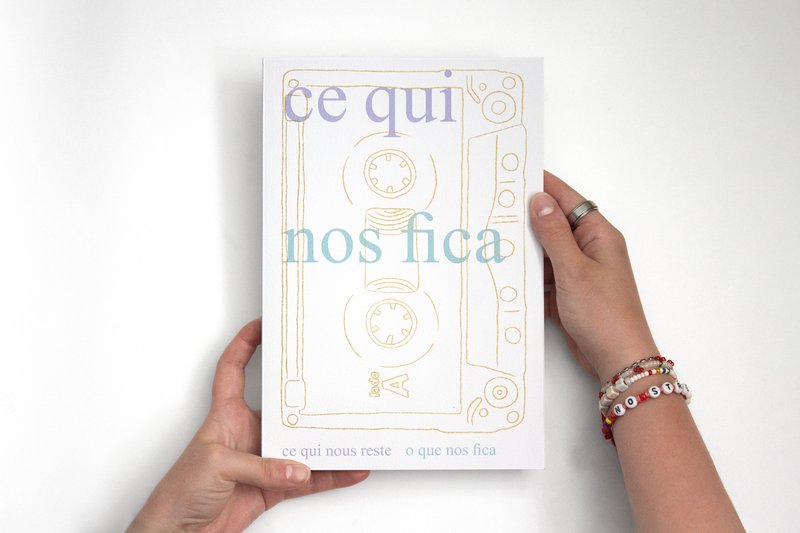
The book Ce qui nos fica brings together Frentuguese, a hybrid French-Portuguese language that emerged within Portuguese immigrant families in French-speaking Switzerland. Through words that were never written down but passed on orally, it captures a memory that is both collective and personal: that of a linguistic, cultural, and familial in-between. The book offers a snapshot of this language, frozen in time as it exists in 2026. What we are left with are not only these words and expressions, but also the memories of the annual journeys between Switzerland and Portugal: the long trips by car or autobus, which are, like us, suspended between two countries. Este livro reúne o frantuguês, uma língua híbrida franco-portuguesa nascida nas famílias da imigração portuguesa na Suíça (França). Através de palavras nunca escritas, mas transmitidas oralmente, ele capta uma memória ao mesmo tempo coletiva e pessoal: a de um entre-dois linguístico, cultural e familiar. A obra propõe assim uma fotografia desta linguagem, fixada no tempo, no seu estado de 2026. O que nos fica são essas palavras, mas também as memórias das viagens anuais entre a Suíça e Portugal: as longas viagens de carro ou de autocarro, que são também elas, como nós, um entre-dois países.

Generated memories

BA GRAPHIC DESIGN

Generated memories

with Guy Meldem

During the Image Creation course with Guy Meldem, students explored the benefits of AI. Feeding the machine with their own illustrative style, they were able to generate a certain quantity of images, enabling them to produce a graphic novel, a collection of images or other types of illustrated editorial work.

Adam Saragoussi – La Soupe

BA GRAPHIC DESIGN

Adam Saragoussi – La Soupe

by Adam Saragoussi

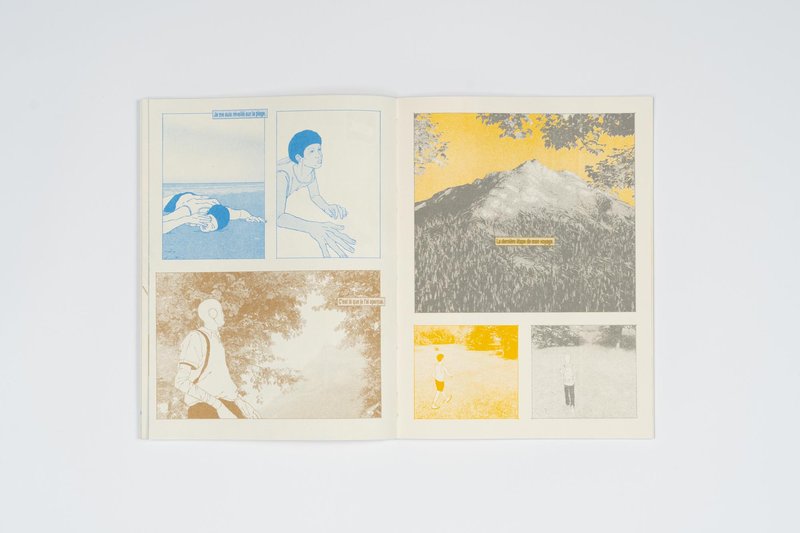
How can new narrative mechanics emerge in comics? La Soupe follows the surreal journey of Clarence and Ludwig in their quest toward the Nucleus of the world. Although they share the same pages, the two characters evolve within distinct parallel realities, each associated with a different printing layer. Developed as a space for narrative exploration, the project investigates the possibilities offered by the coexistence of multiple stories and multiple levels of reading within a single page. The images, combining hand-drawn elements with 3D-set designs, build a universe oscillating between science fiction and dreamlike imagery. Entirely printed in risograph, La Soupe deploys various narrative devices in which realities intersect, contaminate one another, and evolve throughout the story.

Carolina Crivelli – Gossip

BA GRAPHIC DESIGN

Carolina Crivelli – Gossip

by Carolina Crivelli

Gossip is a magazine which explores perceptions of femininity through activities that have historically been — and still are today — associated with women, such as knitting, embroidery and cooking. Every aspect of the magazine aims to reclaim the female mode of transmission, which has until now remained on the margins of history, in a political and feminist way: from the hierarchy between text and image, through the horizontal structure of voices, to the printing process, where areas of white, which are normally never highlighted, are printed and brought to the foreground. In an era marked by the resurgence of misogyny, patriarchy and the concept of the "trad wife", Gossip aims to be a space for rediscovering women's history and discussing the role of our activities within society.

Clara Besson – L'Or du Transvaal / L'Or des DuBois

BA GRAPHIC DESIGN

Clara Besson – L'Or du Transvaal / L'Or des DuBois

by Clara Besson

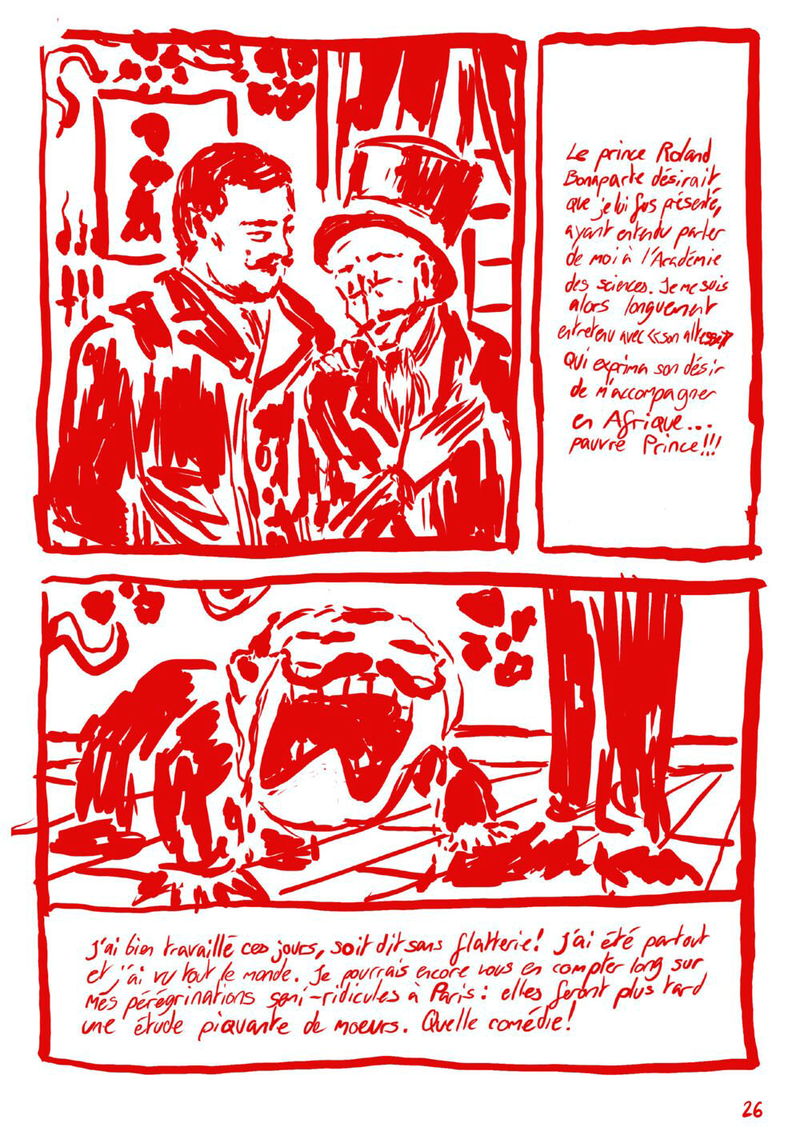
L'Or du Transvaal / L'Or des DuBois is the first volume of the Recto / Verso collection, which aims to encourage Swiss people, and especially young people, to question the history of their country. This volume explores how Switzerland has been and remains imperialist, through the story of the DuBois family from Le Locle, who left to exploit gold in Transvaal in the 19th century. Each double page mirrors two simultaneous realities: the imperialist narrative on the left and its multidimensional critique on the right, the same events told from radically different points of view, by entities that coexist without ever directly interacting. In a context of rising far-right politics across the West, L'Or du Transvaal / L'Or des DuBois intends to fight by the transmission of knowledge beyond academic circles.

Related courses