Résultats pour “Ella needs some help: Bigger BoobsByMaster-TF” (524)

ECAL finaliECAL finalist at the Woolmark Performance Challenge Martin Stricker (BA Industrial Design student) was part of the ten international finalists of the Woolmark Performance Challenge The Woolmark Company and leading sports brand adidashas launched a new annual competition for tertiary students aimed at pushing the limits of product innovation and helping to kick-start the career of the eventual winner. In its first year the award attracted 510studentregistrations from 58 universities from across Europe and NorthAmerica. After travelling to London in September for two days oftraining workshops with The Woolmark Company and partners, the 10 finalists went to Denver, Colorado, to present their entries to an executive judging panel at Outdoor Retailer. https://www.woolmarkchallenge.com/

Archigraphiæ. Rationalist Lettering and Architecture in Fascist Rome Letterforms carry messages – in public space, they are powerful propaganda tools. Witness to this fact are the inscriptions placed on display by Emperors to showcase their power across the Roman Empire. During a Summer School at the Swiss Institute in Rome, ECAL MA in Type Design and ISIA Urbino students explored a more recent avatar of this communication tool. During a Summer School at the Swiss Institute in Rome, ECAL MA in Type Design and ISIA Urbino students explored a more recent avatar of this communication tool. During the fascist era in Italy (1922–1943), the rise to power of Benito Mussolini made his revolutionary political party a ruling institution, which had, as its ambition, the creation of an empire modelled on ancient Rome. The visual aesthetic of the Caesars was captured and used by the fascists to position themselves as successors to a glorious tradition. Imagery and photography also played a part in this endeavour, as did architecture and inscription letters. The buildings and monuments of the 1930s frequently display mottos and texts carved in white marble. Latin and Italian were used, and full capitals, in the ancient Roman tradition. While the design of these letters is based on Ancient models, their shapes are definitely modern; sans serif geometric letterforms. In the first instance, Archigraphiæ sought to collect images of inscriptions on monuments, public buildings, graveyards, street plaques in Rome. Then some of those original designs were digitised to reveal their construction, and the ways in which small elements can be capable of turning a neutral geometrical font into a very Italian-style fascist symbol. By mapping this conspicuous feature of fascist propaganda, the Summer School aimed to deconstruct the mechanisms used to promote political ambitions, and to compare this font with other modernist sans serifs of the time. An analysis of the storytelling behind the use of the letterforms allowed students to develop critical thinking about current (political, commercial, militant) uses of type and lettering.Main applicantsECAL/University of Art and Design Lausanne (project leader) (project leader) Jonathan Pierini (project leader)Research teamLecturers and researchers Chiara Barbieri Gianluca Camillini Pippo Ciorra Emilio Gentile Alessandra Tarquini Paul Shaw Carlo Vinti Assistants StudentsECAL MA Type Design , , , , , , , ECAL MA Photographie ISIA Urbino MA in Communication, Design and Publishing Gianluca Ciancaglini, Alberto Malossi, David Mozzetta, Giuseppe RomagnoPeriodseptember 2018Supported byECAL/University of Art and Design Lausanne ISIA Urbino Istituto Svizzero di RomaDisseminationSummer school Archigraphiæ. Rationalist Lettering and Architecture in Fascist Rome (1921–1943): a Fieldwork, Rome, Istituto Svizzero, September 2–9, 2018. Talks Emilio Gentile, Politica di massa in regime totalitario, Rome, Istituto Svizzero, September 3, 2018. Chiara Barbieri, Graphic design and designers under Fascism: education, practice and exhibitions, Rome, Istituto Svizzero, September 3, 2018. Carlo Vinti, Modernist and traditionalist typography in Fascist Italy, Rome, Istituto Svizzero, September 4, 2018. Pippo Ciorra, Gli architetti di Zevi. Storia e controstoria dell architettura italiana 1944–2000, Rome, MAXXI, September 4, 2018. Exhibition Archigraphiæ. Rationalist Lettering and Architecture in Fascist Rome (1921–1943): a Fieldwork, Rome, Istituto Svizzero, September 8, 2018. Publication Matthieu Cortat, Davide Fornari, Archigraphiæ. Rationalist Lettering and Architecture in Fascist Rome / Architettura e iscrizioni razionaliste nella Roma fascista, Renens: ECAL 2020 (contributions by Chiara Barbieri, Gianluca Camillini, Joëlle Comé, Jonathan Pierini, Paul Shaw, Alessandra Tarquini, Carlo Vinti).

CIBONE ♡ ECAL in Japan,31.08.2018,Cibone, Tokyo CIBONE ♡ ECAL boutique exhibition. Boutique exhibition from 31 August to 18 September 2018 Opening cocktail and talk on Friday 31 August, from 6.30 pm to 9 pm Open every day 11 am — 9 pm IMAGES HD Industrial design students produce around a dozen products of all kinds during their studies at ECAL. Some will remain at the stage of prototypes and will be written about in the printed or online press, while a select few will be further developed in collaboration with a brand and become products in their own right, and potentially successful ones. CIBONE ♡ ECAL boutique exhibition showcases a selection of recently released products and publications which started life at ECAL, ranging from mesmerising mobiles for Japanese brand tempo, to “The Sausage of the Future”, an eye-opening book now published by renowned Swiss publishing company Lars Müller, Malvaux s new take on the iconic Swiss Army knife, playful souvenirs for The Olympic Museum gift shop, Policosmos Animal toy families by PCM of Spain and the versatile Phare LED Lamp produced by Danish brand Menu. CIBONE Aoyama 2F 2-27-25 Minamiaoyama Minato-Ku Tokyo 107-0062 Visual by ECAL/Valentin Kaiser

Bobst Graphic 1972–1981 Bobst Graphic, 1972–1981, with a preface by François Rappo, an interview with six important actors and further selected texts, documents, at a distance of 48 years, the hitherto relatively unknown history of a Bobst company division: Bobst Graphic, pioneers in photocomposition. At the beginning of the 1970s, Bobst, a packaging company already far advanced in packaging manufacture, decided to start to sell its photocomposition machines with a view, amongst other things, to improving Swiss typographical quality. It started to manufacture a series of innovative photocomposition machines, patented by their French inventors, Hugonnet and Moyroud. Bobst Graphic products, with their streamlined service and close collaboration with first-rate researchers, soon came to occupy a secure position in photocomposition, now called on to assume the mantle of a hundred-year-old traditional profession. Numerous families of typographical characters were developed, some from scratch, with the help of many of the best graphic artists in the country, some, like Team 77, which boasted international renown. Despite the energy invested in these new inventions, and the signal advantage enjoyed by this division with its considerable in-house talents, the company faced stiff competition internationally, almost exclusively from the United States. Ultimately, financial difficulties obliged the firm to hand over its project to Autologic, an American company. We are able, by exhibiting this archive, to tell a story which might never have received the attention it truly deserves within the context of Swiss graphic design.Main applicantsECAL/University of Art and Design Lausanne (project leader)Research team (researcher) (supervisor) (supervisor)PeriodApril 2017 – August 2018Supported byStrategic fund of the University of Applied Sciences Western Switzerland (HES-SO RCDAV)DisseminationPublication Giliane Cachin (ed.), Bobst Graphic 1972–1981, Zurich: Triest verlag, 2019 (with contributions from Bruno De Kalbermatten, Robert Flach, Roland Jan, Christian Mengelt, Jean-Luc Monnard, Jean-Daniel Nicoud, François Rappo). Talks Launch of the Archives visuelles series, with Giliane Cachin, Davide Fornari, Sarah Klein, Robert Lzicar, Simon Mager, Andrea Wiegelmann, Zurich, Never Stop Reading, 29 January, 2020. Press Claudia Gerdes, Bobst Graphic 1971–1981, in Page Magazine, March 2020, p. 62.

Giulio Barresi – Tools for Connected Humans Nowadays, smartphones are seen as an extension of the human being. Both a tool and a distraction, these devices make it difficult to focus due to a digital overload of social interactions. The ability to interact with others without a connected devices is fading away. As an interaction designer, I question our actual relationship with technology face its utterly promises to shape a better world. In the search for space for more disconnected interactions, I designed Tools for Connected Humans. A series of connected devices ready to help the user disconnect from connectivity.

Callum Ross – You can t see the mountain from the peak In the present day, the evolution of the quality of CGI forces us to question our relationship to digital representations of our world and the impact they have on us. This project explores the current ambiguity of the digital image through an interactive short film based around mountain imagery, used for its symbolism of an everlasting geological phenomenon, but which paradoxically, are some of the fastest images to generate. Through the use of a smartphone, we navigate this variable experience between real and virtual, gradually questioning the reality of the situation that is shown.

Ondřej Báchor – Kolektiv. Diploma Project by Ondřej Báchor Kolektiv is a high contrasted transitional serif typeface that comes in 8 cuts including Italics. Intended as a book typeface, it is suitable in small sizes where its smooth ductus creates an organic text structure, as well as for headline sizes where it excels in its elegant style of drawing. It s a digital interpretation of a design by the same name drawn in 1952 by a collective of Czech authors. As a Czech designer, Kolektiv is my personal statement of what I consider Czech character in typography to be. The process of designing helped me to shape my own style and apply it to the typeface. Kolektiv is a high contrasted transitional serif typeface that comes in 8 cuts including Italics. Intended as a book typeface, it is suitable in small sizes where its smooth ductus creates an organic text structure, as well as for headline sizes where it excels in its elegant style of drawing. It s a digital interpretation of a design by the same name drawn in 1952 by a collective of Czech authors. As a Czech designer, Kolektiv is my personal statement of what I consider Czech character in typography to be. The process of designing helped me to shape my own style and apply it to the typeface.

Aesop x ECAL,21.06–15.07.2018,Aesop Oberdorfstrasse, Zurich An exhibition of projects by ECAL Master of Advanced Studies in Design for Luxury & Craftsmanship students in collaboration with Aesop. From 21 June (opening reception from 6.30pm) to 15 July, Aesop Oberdorfstrasse, Zurich. The skincare, haircare and body products specialist Aesop chose ECAL/University of Art and Design Lausanne to design two accessories for its brand : an electric essential oil burner and a washbag. In doing so, Aesop clearly showed it cared for smart and sustainable design. After an in-depth presentation and a visit to the three Aesop shops in Zurich, 17 ECAL graduate students from the MAS in Design for Luxury & Craftsmanship started working under the leadership of professor and designer Tomas Kral. At the end of the workshop, a jury made up of some of the brand executives – among them Mandy Cupper, Head of Product, who had made the trip from Melbourne especially – selected some twenty projects that explored materials as varied as wood, cork, natural resins, ceramic, hand-blown glass and textile. In addition to an aesthetic and innovating design, the students brief included sustainability. Through working prototypes, students imagined projects such as a neoprene washbag inspired from the surfing world or a pocket-size foldable washbag, an essential oil burner producing steam reminiscent of Japanese mountains and a completely transparent oil burner revealing its fan blades and its usual bottle of essential oils. All the other projects also have their own distinctive world in which our bodies and minds are invited to travel through our senses of sight, smell and touch. Exhibition from 22 June until 15 July 2018 Opening Reception: Thursday 21 June, from 6.30pm to 8.30pm Opening hours: Monday - Friday 10am - 7pm, Saturday 10am - 6pm. Aesop Oberdorfstrasse Oberdorfstrasse 2 CH - 8001 Zurich www.aesop.com

Platform 10 Platform10 is the transformation of a railway and industrial site to a new district entirely dedicated to to culture. The space, some 22,000 square meters, hosts three recognized cultural institutions: the Cantonal Museum of Fine Arts, the Museum of the Elysée and the Museum of design and contemporary applied arts, to a few steps from the station, in the centre of Lausanne . In order to complete this major transformation, Platform 10 launched a competition (by invitation) , in which the 2nd year students took part to design coherent propositions of outdoor (urban) furniture for this new public space.

Exhibition Aesop, Zurich,01.06.2018 The skincare, haircare and body products specialist Aesop chose ECAL/University of Art and Design Lausanne to design two accessories for its brand : an electric essential oil burner and a washbag. In doing so, Aesop clearly showed it cared for smart and sustainable design. After an in-depth presentation and a visit to the three Aesop shops in Zurich, 17 ECAL graduate students from the MAS in Design for Luxury & Craftsmanship started working under the leadership of professor and designer Tomas Kral. At the end of the workshop, a jury made up of some of the brand executives – among them Mandy Cupper, Head of Product, who had made the trip from Melbourne especially – selected some twenty projects that explored materials as varied as wood, cork, natural resins, ceramic, hand-blown glass and textile. In addition to an aesthetic and innovating design, the students brief included sustainability. Through working prototypes, students imagined projects such as a neoprene washbag inspired from the surfing world or a pocket-size foldable washbag, an essential oil burner producing steam reminiscent of Japanese mountains and a completely transparent oil burner revealing its fan blades and its usual bottle of essential oils. All the other projects also have their own distinctive world in which our bodies and minds are invited to travel through our senses of sight, smell and touch.

Collaboration with Aesop The skincare, haircare and body products specialist Aesop chose ECAL/University of Art and Design Lausanne to design two accessories for its brand : an electric essential oil burner and a washbag. In doing so, Aesop clearly showed it cared for smart and sustainable design. After an in-depth presentation and a visit to the three Aesop shops in Zurich, 17 ECAL graduate students from the MAS in Design for Luxury & Craftsmanship started working under the leadership of professor and designer Tomas Kral. At the end of the workshop, a jury made up of some of the brand executives – among them Mandy Cupper, Head of Product, who had made the trip from Melbourne especially – selected some twenty projects that explored materials as varied as wood, cork, natural resins, ceramic, hand-blown glass and textile. In addition to an aesthetic and innovating design, the students brief included sustainability. Through working prototypes, students imagined projects such as a neoprene washbag inspired from the surfing world or a pocket-size foldable washbag, an essential oil burner producing steam reminiscent of Japanese mountains and a completely transparent oil burner revealing its fan blades and its usual bottle of essential oils. All the other projects also have their own distinctive world in which our bodies and minds are invited to travel through our senses of sight, smell and touch.

Panic Button Panic Button is a project which helps stressed out users face the difficulties they can encounter whilst working on a computer. The button works as an extension of the keyboard. In case of panic, the user can activate it and the interface will help them relax and overcome the stressful situation. Initial project made during a one-week workshop with Florian Pittet. Video produced during a workshop led by Sebastian Vargas.

TIE Picasso, Giacometti, ECAL. Some projects sometimes give rise to what may first seem to be unlikely associations. In this case, it turned out for the best. The Musée national Picasso-Paris challenged ECAL to create new seats, at once practical and discreet and yet with distinctive character, for the exhibition areas. We rose to the challenge. In order to best respond to the visitors needs, ECAL commissioned a group of nine students and graduates to carry out a study on the seats of fifty museums or so in Europe (Germany, England, Spain, France, Italy, the Netherlands and Switzerland). Inspired by this survey, 2nd year Bachelor Industrial Design students worked with materials of their choice under the guidance of designer and professor Chris Kabel. Isabelle Baudraz s ‘Tie bench was selected from the projects put forward before being assessed in situ to make sure it blended with the architecture of the museum and the works of the Spanish genius. The benches were finally produced by the outdoor furniture company Tectona. All the project participants worked in a concerted manner and the project was a great success. Picasso and Giacometti can definitely sit easy. Photographs by ECAL/Calypso Mahieu and Matthieu Gafsou

ECAL x Musée national Picasso-Paris x Tectona,17.05–04.11.2018,Tectona Showroom, Milan The Musée national Picasso-Paris presents an exhibition of its new benches, which were created by Isabelle Baudraz, ECAL Bachelor Industrial Design student, and produced by Tectona. UPDATE: Exhibition at the Musée national Picasso-Paris From 17 May to 4 November 2018, the Musée national Picasso-Paris presents an exhibition of its new benches, which were created by Isabelle Baudraz, ECAL Bachelor Industrial Design student, and produced by Tectona (more info below). All days, except Mondays 10:30-18:00 (9:30-18:00 during school holidays and weekends) Musée national Picasso-Paris 5 rue de Thorigny 75003 Paris www.museepicassoparis.fr In partnership with the Musée national Picasso-Paris, ECAL and the French outdoor furniture company Tectona present during the Milan Design Week a preview of the new benches created by Bachelor Industrial Design student Isabelle Baudraz for the renowned Parisian museum. HD Images Brochure with explanations Picasso, Giacometti, ECAL. Some projects sometimes give rise to what may first seem to be unlikely associations. In this case, it turned out for the best. The Musée national Picasso-Paris challenged ECAL to create new seats, at once practical and discreet and yet with distinctive character, for the exhibition areas. We rose to the challenge. In order to best respond to the visitors needs, ECAL commissioned a group of nine students and graduates to carry out a study on the seats of fifty museums or so in Europe (Germany, England, Spain, France, Italy, the Netherlands and Switzerland). Inspired by this survey, 2nd year Bachelor Industrial Design students worked with materials of their choice under the guidance of designer and professor Chris Kabel. Isabelle Baudraz s ‘Tie bench was selected from the projects put forward before being assessed in situ to make sure it blended with the architecture of the museum and the works of the Spanish genius. The benches were finally produced by the outdoor furniture company Tectona. All the project participants worked in a concerted manner and the project was a great success. Picasso and Giacometti can definitely sit easy. Opening hours Monday 16 April – Saturday 21 April, 10 am – 7 pm Tectona Showroom Via della Moscova 47/a 20121 Milano www.tectona.net www.museepicassoparis.fr

Symposium Eco-monde: horizons nouveaux Can we move from one world to another, from one period of human history to another, and still create forms, produce meaning, sell art, as if nothing had happened? To slip into a new era without taking it into account? Between the countdown of the ecological catastrophe and the new environmental conscience, we are in the process of changing paradigm, and of entering, without always knowing it, often backwards, in an unknown universe, where the political, social, scientific, artistic questions are no longer posed in the same terms. Where was the man ("ecce homo") is imposed today the interdependence of the forms of life ("to like the echo?"). Where Prometheus was unleashed, with his myth of progress and his dogma of development, a new concern arises, still badly understood, that of lasting, of letting live, of abstaining. Where substance reigns, that of products, resources, certainties, a new question now insinuates itself: the atmosphere, a matter of ambiance and resonance, of airy spirits and the bewitchment of things. And where anthropocentrism triumphed for a long time, as an imperial posture, the ground is cracking under the feet of Man, who loses his capital letter, his arrogance, his solitude too. Of this obliged ecological turn of the late modernity, the art and the culture cannot not take account. They must find a new tone, in tune with the perils, the urgencies, but also the humility and the breadth of vision required by these new times. They must explore new themes, which frenetic capitalism and the dramas of history had relegated to the background. Above all, they need to think together things that have been separated for centuries: objects and lives, air and meaning, micro and macro, time and space. It is these vast problems that the symposium will address. It is in this spirit that it will shake up our habits. It is with as much joy as questioning, with freedom as with open dialogue, that it will tackle head on the revolution in progress, and its crucial stakes for the art world - and for the simple fact of creating. We will talk about the Anthropocene, green finance, vital decay, militant slush, the relationship between the environment and the extremities, and many other things. Keeping in mind, in order not to disarm, that it is not a question of defending nature, but rather, today more than ever, of being the nature that defends itself.

ECAL Design for Luxury and Craftsmanship exhibition at The Mass, Tokyo,24.03–22.04.2018,The Mass, Tokyo At The Mass gallery s invitation, ECAL/University of Art and Design Lausanne is presenting a selection of Master of Advanced Studies in Design for Luxury & Craftsmanship student projects. Founded in 2016 by Masayuki Nishimoto, the gallery welcomes the exhibition in the three sculpturally designed rooms that give the Tokyo minimalist architect Nobuo Araki s building its distinctive character. The exhibition is organised around three themes (Fine Tableware, Swiss Craftsmanship and Fashion Accessories) and it highlights some of the many collaborations undertaken with Swiss brands from the fields of luxury and craftsmanship. In addition to the exhibited prototypes, a selection of mock-ups and sketches illustrates the students creative process. Opening reception on Friday 23 March, 7pm-9pm From 23 March to 22 April 2018 With the support of the Swiss Embassy in Tokyo and Presence Switzerland The Mass 5-11-1 Jingumae, Shibuya-Ku, Tokyo 150-0001, JAPAN http://themass.jp

Exhibition at The Mass, Tokyo,24.03.2018 At The Mass gallery s invitation, ECAL/University of Art and Design Lausanne is presenting a selection of Master of Advanced Studies in Design for Luxury & Craftsmanship student projects. Founded in 2016 by Masayuki Nishimoto, the gallery welcomes the exhibition in the three sculpturally designed rooms that give the Tokyo minimalist architect Nobuo Araki s building its distinctive character. The exhibition is organised around three themes (Fine Tableware, Swiss Craftsmanship and Fashion Accessories) and it highlights some of the many collaborations undertaken with Swiss brands from the fields of luxury and craftsmanship. In addition to the exhibited prototypes, a selection of mock-ups and sketches illustrates the students creative process. With the support of the Swiss Embassy in Tokyo and Presence Switzerland The Mass 5-11-1 Jingumae, Shibuya-Ku, Tokyo 150-0001, JAPAN http://themass.jp

Summer University CUBA After marking the history of the twentieth century with major episodes, Cuba must confront a new historical turning point. Obama s opening speeches and the death of Fidel Castro, leader of the Cuban Revolution of 1959, push the country towards a paradigm shift without priors. Partial liberalisation measures (restaurants, taxis and tourist activities) create an uncertain balance between mass tourism and Communist historical anchorage. The will of the workshop led by Milo Keller (head of photography) and Vincent Jacquier (Head of visual communication) was to rethink the visual relationship that the collective imaginary maintains with Cuba. It was for the students to get out of the tourist cliché, be it the old American car, the colorful colonial houses or the cigar. In partnership with the Embassy of Switzerland in Cuba, this week has been punctuated by many cultural visits. Exchanges with institutions such as the Instituto Superio de Arte (ISA) and the Fototeca de Cuba, as well as meetings with photographers who have worked for decades in Cuba as Sven Creutzmann and Vives-Figueroa, allowed an understanding finer Cuban culture, with exchanges around photographic, educational and policy approaches. The architecture has been one of the major themes, whether through visits to buildings of Porro and Gottardi, or even a visit to the Swiss Ambassador s residence, designed by Richard Neutra. With the help of the Embassy of Switzerland, the students were guided by four local photographers: Raul Canibano, Chino Arcos, Gabriel Guerra and Lissette Solórzano and they were able to get in places and invisible to tourists Havana networks. The projects are varied: technology report was addressed by Margaux Piette in a film about the hot spots Wifi scattered through the city. but also in the photos of Ivo Fovanna centered on the package, physical network for the exchange of files hacked; or in the film of Tatiana Mégevand on tourism activities Airbnb and economic change involved. The social characteristics of Cuba themselves in the series Olivia Schenker and Julien Deceroi. The first has made portraits of LGBTQ minority which enjoys a special acceptance on the island. The second makes us discover Santería, majority religion in Cuba of Christian inspiration and Voodoo. Imported cultural trends was put forward by the skaters in the movie of Pierre-Kastriot Jashari and more vernacular aspects are revealed in this series of Vincent Levrat pigeons collected on roofs by the inhabitants of Havana. The eighteen projects of this workshop were presented in the form of a projection at the Fototeca of Cuba on Vendredi8 December, in the presence of the Swiss ambassador, Mr Stutz and local photographers. This workshop was an opportunity of discovery cultural and social, but also a framework that helped improve the autonomy and ambition projectual students.

Workshop Point and shoot Under the guidance of Paul Wolfson and Alex Hulme, designers at Map Project Office, 3rd year Industrial Design Bachelor students and Media & Interaction Design Bachelor students have conceived "point-and-shoot" objects. Those ones were inspired by the opportunities created by this new wave of Open Source and could be made easily available to people who might need or want them.

Augmented Photography – 2017 Photography has contributed, throughout its history, to building up a framework of knowledge based on an ability to demonstrate visibly, and therefore objectively, the reality of things. The widespread nature of digital imagery – images that have been created, processed, disseminated or stored as digital data – has led us to review critically the precision of our gaze. In the past, photographic images were deemed to be trustworthy and irrefutable documents. They have now become malleable and plausible data that we instantly assimilate into our visual habits. Since the 1990s, this development has given rise to considerable discussion about the nature of photographic realism, and a questioning of entire areas of activity. The digital creation of images has been accompanied by their manipulation in ways that are similar to painting, sculpture and, more analytically, the computer sciences. In this respect, Web 2.0, by facilitating in the circulation of ideas, things and persons at unprecedented speed, has further accelerated a process that began with the advent of the Internet. This research project allowed us to experiment with new practices and analyse the positions adopted by influential actors, such as photographers, critics and curators. It offered participants conceptual and practical tools to allow them to position themselves in hyper-connected environments. In the absence of any master s degrees in photography in Switzerland, this research helps provide a robust theoretical framework and a way of keeping abreast of the shifting nature of the discipline.Main applicantsECAL/University of Art and Design Lausanne (project leader)Research team (researcher) (research assistant)Visiting lecturersAnn-Christin Bertrand, Estelle Blaschke, Rachel de Joode, Marco De Mutiis, Anne de Vries, Christophe Gaillard, Claus Gunti, Joe Hamilton, Kim Knoppers, Nicolas Nova, Harm Van Den DorpelPeriodoctober 2016 – october 2017Supported byECAL/University of Art and Design Lausanne Strategic fund of the University of Applied Sciences Western Switzerland (HES-SO RCDAV)DisseminationPublication Augmented Photography, edited by Milo Keller, Joël Vacheron and Maxime Guyon, ECAL, Renens, 2017 Website augmented-photography.ch

IKEA Democratic Design Day 2017 at ECAL,22.09.2017,IKEA Auditorium, ECAL IKEA is working together with ECAL and the Ikea Foundation Switzerland to organise the Democratic Design Day 2017. IKEA is working together with ECAL and the Ikea Foundation Switzerland to organise the Democratic Design Day 2017 on 22 September 2017 from 9.30am to 5.30pm. Entitled The Future of Living at Home , the event will feature internationally renowned experts in design, architecture and sociology explaining how they are working on the future of private living spaces and the solutions they have developed to tackle the challenges that come with digitalisation and trying to follow a more sustainable way of life. The conference is being held in the IKEA Auditorium at ECAL. You can sign up at www.ikeaddd.ch . There are a limited number of seats available and places will be allocated on a first come, first served basis. You can find more information about the programme and the keynotespeakers at the previous address. Mario Bellini, Designer and architect, Milan Simonetta Carbonaro, Sociologist, Karlsruhe Kim Colin, Designer – Industrial Facility, London Matali Crasset, Designer, Paris Marcus Engman, Head Designer IKEA of Sweden Oliver Herwig, Journalist and author, Karlsruhe Antonio Scarponi, Architect and designer, Zurich Workshops Two workshops will run simultaneously on Thursday 21 September in the run-up to the Democratic Design Day. In cooperation with Design Prize Switzerland, they will examine and explore the issue of the ageing society – how designers can respond to this development and what concepts and methods they can use to create integrated, accessible products and services that span the generations. The second workshop deals with living off-grid. A team from the design department of IKEA of Sweden (IoS) invites you along to develop ideas for life that goes on outside of the networks. How do people live when they opt out for a while and seek both spatial and technological freedom? Where do these needs come from and what does it mean for their living space? You can sign up here for one of the two workshops. There are a limited number of places available: www.ikeaddd.ch ECAL 5, avenue du Temple CH-1020 Renens www.ecal.ch

The Sausage of the Future Can we count on the sausage to provide a solution, in order to reduce the consumption of meat? And can the use of new ingredients increase the diversity of our diets? Can the sausage make a considerable contribution to a sustainable food culture? To answer these questions, a chef of molecular gastronomy, a master butcher and a designer have teamed up to look into sausage production techniques and potential new ingredients – such as insects, nuts, and legumes – to reinvent the sausage of the future. The final publication Sausage of the Future takes the reader on a journey through all the building blocks of a sausage. It stops along the way to explore issues like moistness, flavoring, glue, and preservation. The publication catalogues different types of sausages and presents lesser-known ingredients, carefully selected for their potential regarding the future. In our days, according to the Food and Agriculture Organization (FAO), we are facing a serious shortage of protein-rich-food. The reason is the overconsumption of animal products. Meat, in particular, will be scarce: thus, we need alternatives. The sausage is one of mankind s first-ever designed food items. A paragon of efficient butchery, it was originally designed to make the most of animal protein in times of scarcity. With its wide variety of sizes and its endless choice of possible fillings, the sausage offers itself again to take a pioneering role. This time, not only to make the most of animal protein, but to be a shell for all kinds of nutrition.Main applicantsECAL/University of Art and Design Lausanne (project leader)Research teamSupervision Mock-ups Gabriel Serero Herman ter Weele Graphic design and illustrations Helge Hjorth Bentsen Olli Hirvonen Photography Emile Barret Noortje Knulst Jonas MarguetPeriodmarch 2014 – november 2017Supported byECAL/University of Art and Design LausanneDisseminationPublication Carolien Niebling, The Sausage of the Future, Zurich: Lars Müller Publishers, 2017. Exhibitions Design Parade, Hyères, Villa Noailles, June 30 – Sept 24, 2017. Hublot Design Miami, Miami, December 7, 2017. The Sausage of the Future, Milan, SaloneSatellite, April 4–9, 2017. WantedDesign, Brooklyn, May 17–21, 2018. Design Parade, Hyères, Villa Noailles, June 29 – September 23, 2018. Dutch Design Week, Eindhoven, Strijp, October 20 – 28, 2018. Food Revolution 5.0, Winterthur, Gewerbemuseum, December 2, 2018 – April 28, 2019 FOOD: Bigger than the plate, London, Victoria and Albert Museum, May 18 – October 10, 2019. Broken Nature: Design Takes on Human Survival, Milano, Triennale, March 01–November 09, 2019. Serial Eater, Hornu, CID Grand-Hornu, May 27 – November 29, 2020. Design Preis Schweiz, Langenthal, November 02 – 10, 2019. Awards Winner of Design Prize Switzerland (Research) – 2019 Winner of Norway s most beautiful books competition (Nonfiction) – 2018 Silver Hare (second prize) in Hochparterre s Die Besten (design and research category) – 2017 Winner of Hublot Design Prize – 2017 Winner of Design Parade Hyères Grand Prix at Villa Noailles – 2017 Press Penelope Vaglini, The Future Sausage, lofficielitalia.com, 11 mai 2017 Phillip Löwe, Wurst case scenario, Spiegel.de, 10 avril 2017 Emma Rawson, In search of the missing link: Tasting the future of sausage with Carolien Niebling, thisNZlife.co.nz, 12 Septembre 2019 Daphne Milner, Designer Carolien Niebling wants you to meet the meat we eat, itsnicethat.com, 25 Avril 2018 Spencer Bailey, How the Sausage Is Made, Literally, surfacemag.com, 30 décembre 2017 Alexander Kühn, Die Wurst der Zukunft, tagesanzeiger.ch, 7 décembre 2017 Dutch food designer Carolien Niebling on why the future of food might not be fake meat or veganism, but sausages, idealog.co.nz, 22 août 2019 Katharine Schwab, The Sausage Gets A Radical Redesign, Fastcompany.com, 4 juillet 2017 Sofia Lekka Angelopoulou, the future sausage by carolien niebling wins the design prize switzerland 2019, designboom.com, 2 novembre 2019 Ali Morris, Alternatives for meat consumption to be explored by ECAL during Milan design week, dezeen.com, 29 mars 2017 Conferences And the day after? lecture, TEDxGeneva, Geneva, March 22, 2018 Semi-Permanent, lecture, Semi-Permanent, Auckland, August 15, 2019 Design Indaba conference, lecture, Design Indaba, Cape Town, February 27, 2019 Future of Production, Panel talk, Global Design Forum at V&A, London, September 14, 2019 Sustainability by Design: Innovation for a Circular Economy, Panel talk, Swissnex, San Francisco, January 14, 2020

Mélanie Courtinat – I never promised you a garden I never promised you a garden offers an immersive journey inside a fantasized hanging garden using virtual reality. The public is invited to walk among chimeric plants and make them blossom with a simple touch. Having noticed that some spectators have a tendency to be uninvolved and passive before an interactive design artwork, this project questions their willful participation. What is to be done when a spectator makes the conscious choice to not interact with an interactive project? What is the design of refusal?

Patrick Muroni – Foulek Niels, a twenty-year-old young man, rediscovers a friend became professional rap artist. Fiction / 18 min Synopsis Overwhelmed by loneliness and the inertia of his country life, Niels, a twenty-year-old young man, does not endeavour to embellish his everyday life anymore. One day, a childhood friend is back in the village. She has become a professional rap artist. Niels both rediscovers his friend and her texts. Commentaire Foulek or the introspection of a young man in need of reference, whose "only homeland is rap." Patrick thus continues to question his relationship to the world through hard-hitting rhymes that mix violence, solitude and obstinacy, against a backdrop of romance. A bluffing direction of actor, a fragile thread that the director unrolls and holds from beginning to end, a film with a tense flow, like an intimate flow that reveals the fragility of this world of youth, where everything should still be possible.

"Workbays Village" exhibition in collaboration with Vitra,29.06–24.09.2017,Port des créateurs, Toulon Following a workshop led by Camille Blin and Erwan Bouroullec, Master Product Design students of ECAL present projects around the Workbays created by Ronan & Erwan Bouroullec and edited by Vitra. Together with new functionalities, these prospective work environments are presented on the occasion of Design Parade Toulon – festival international d architecture d intérieur. DOWNLOAD IMAGES HD DOWNLOAD POSTER With Workbays, which they created for Vitra a few years ago, the French designers Ronan & Erwan Bouroullec, who regularly collaborate with ECAL, have developed a micro-architectural system that redefines the working environment and breaks with the typical rigid planning structure of offices. Thus Workbays create distinct areas where individuals or groups can retreat from the general office environment to carry out specific activities. The units come equipped with everything users need: work surfaces, seating, optional storage and power connections. The structure of Workbays consists of slim aluminium profiles and organically shaped wall elements made of pressed polyester felt. “The ECAL students suggested we devised new typologies for these working environments, adding novel features and supplying them with new accessories”, says Camille Blin, the designer and professor who headed the project. So the Master Product Design students worked for a full semester under the watchful eye of Erwan Bouroullec and invented new structures that call to mind Japanese 0capsule hotels, a prototyping workshop, a gym, a bar, a garden or a resting area. For each of these spaces, the students created specific and original objects, ranging from Bluetooth loudspeakers to miniature lamps reminiscent of stadium ones, desk pads-cum-bags, a semi-standing stool, a cable-covering carpet, in & out wastepaper baskets, multi socket trays or a desk partition with vases and drawing pins. A 3D animation film specifically created by TRAUM Inc. presenting these unusual Workbays can also be seen at the exhibition. Opening reception on Thursday 29 June 2017 from 6.30 pm to 21 pm at the Port des Créateurs Exhibition from 30 June to 2 July, from 10am to 6pm during the Festival. Then until 24 September, from Monday to Saturday, from 9am to 7pm. Le Port des Créateurs Place Savonnières 83000 Toulon www.villanoailles-hyeres.com www.ecal.ch www.vitra.com

Giacomo Bastianelli – Next Eleven Paper The next wave of renewal for music scenes comes from the developing world of the “Next Eleven” countries. Their over-driven economic metabolisms generate all manner of social tensions and cultural rifts, which generates some 21st Century musical form. That non-Western folk forms, colliding with digital technology, will spawn some avant-garde new sound. A form where sound is fully meshed with visual imagery. Next Eleven Paper redefines the way we promote music and fills the gap between physical object and digital media. The first number is set in Mexico City. The next wave of renewal for music scenes comes from the developing world of the “Next Eleven” countries. Their over-driven economic metabolisms generate all manner of social tensions and cultural rifts, which generates some 21st Century musical form. That non-Western folk forms, colliding with digital technology, will spawn some avant-garde new sound. A form where sound is fully meshed with visual imagery. Next Eleven Paper redefines the way we promote music and fills the gap between physical object and digital media. The first number is set in Mexico City.

Claire Bourrassé – Alter Ego – 2017 In the evening you re heading home alone. You will sleep alone at night. Sometimes you open your eyes, drowsy, your mind still plunged into a dream. It is there. Emptiness. In your lifetime you have felt it already many times. How can this void, by definition the absence of everything, be transformed into a feeling? You have to know that your shadow is a friend, the only one that is a constant; it accompanies your empty body and never abandons you. This book is a research into identity, which is based on duality, on the need to project on to someone else in order to define oneself. In the evening you re heading home alone. You will sleep alone at night. Sometimes you open your eyes, drowsy, your mind still plunged into a dream. It is there. Emptiness. In your lifetime you have felt it already many times. How can this void, by definition the absence of everything, be transformed into a feeling? You have to know that your shadow is a friend, the only one that is a constant; it accompanies your empty body and never abandons you. This book is a research into identity, which is based on duality, on the need to project on to someone else in order to define oneself.

Aporetic Spectacle Aporetic Spectacle researches the changing nature of photographic pictures as extensions of human perception. The photographs are the result of repetitive parametric captures by a computational camera mounted below an autonomous drone. As latent images dissolve into data, the smallest deviation in the dataset results in an unconscious and uncontrolled distortion of traffic flow. The emergence of the sign of a hidden and imperceptible infrastructure is also a metaphor for the need for photography to have a physical basis, even for disembodied computational photographs. Aporetic Spectacle researches the changing nature of photographic pictures as extensions of human perception. The photographs are the result of repetitive parametric captures by a computational camera mounted below an autonomous drone. As latent images dissolve into data, the smallest deviation in the dataset results in an unconscious and uncontrolled distortion of traffic flow. The emergence of the sign of a hidden and imperceptible infrastructure is also a metaphor for the need for photography to have a physical basis, even for disembodied computational photographs.

ECAL x Vitra Following a workshop led by Camille Blin and Erwan Bouroullec, Master Product Design students of ECAL present projects around the Workbays created by Ronan & Erwan Bouroullec and edited by Vitra. Together with new functionalities, these prospective work environments are presented on the occasion of Design Parade Toulon – festival international d architecture d intérieur. With Workbays, which they created for Vitra a few years ago, the French designers Ronan & Erwan Bouroullec, who regularly collaborate with ECAL, have developed a micro-architectural system that redefines the working environment and breaks with the typical rigid planning structure of offices. Thus Workbays create distinct areas where individuals or groups can retreat from the general office environment to carry out specific activities. The units come equipped with everything users need: work surfaces, seating, optional storage and power connections. The structure of Workbays consists of slim aluminium profiles and organically shaped wall elements made of pressed polyester felt. “The ECAL students suggested we devised new typologies for these working environments, adding novel features and supplying them with new accessories”, says Camille Blin, the designer and professor who headed the project. So the Master Product Design students worked for a full semester under the watchful eye of Erwan Bouroullec and invented new structures that call to mind Japanese 0capsule hotels, a prototyping workshop, a gym, a bar, a garden or a resting area. For each of these spaces, the students created specific and original objects, ranging from Bluetooth loudspeakers to miniature lamps reminiscent of stadium ones, desk pads-cum-bags, a semi-standing stool, a cable-covering carpet, in & out wastepaper baskets, multi socket trays or a desk partition with vases and drawing pins. A 3D animation film specifically created by TRAUM Inc. presenting these unusual Workbays can also be seen at the exhibition. Following a workshop led by Camille Blin and Erwan Bouroullec, Master Product Design students of ECAL present projects around the Workbays created by Ronan & Erwan Bouroullec and edited by Vitra. Together with new functionalities, these prospective work environments are presented on the occasion of Design Parade Toulon – festival international d architecture d intérieur.With Workbays, which they created for Vitra a few years ago, the French designers Ronan & Erwan Bouroullec, who regularly collaborate with ECAL, have developed a micro-architectural system that redefines the working environment and breaks with the typical rigid planning structure of offices. Thus Workbays create distinct areas where individuals or groups can retreat from the general office environment to carry out specific activities. The units come equipped with everything users need: work surfaces, seating, optional storage and power connections. The structure of Workbays consists of slim aluminium profiles and organically shaped wall elements made of pressed polyester felt. “The ECAL students suggested we devised new typologies for these working environments, adding novel features and supplying them with new accessories”, says Camille Blin, the designer and professor who headed the project. So the Master Product Design students worked for a full semester under the watchful eye of Erwan Bouroullec and invented new structures that call to mind Japanese 0capsule hotels, a prototyping workshop, a gym, a bar, a garden or a resting area. For each of these spaces, the students created specific and original objects, ranging from Bluetooth loudspeakers to miniature lamps reminiscent of stadium ones, desk pads-cum-bags, a semi-standing stool, a cable-covering carpet, in & out wastepaper baskets, multi socket trays or a desk partition with vases and drawing pins.A 3D animation film specifically created by TRAUM Inc. presenting these unusual Workbays can also be seen at the exhibition.

PUMP – The Punkt. Urban Mobility Project The Swiss technology company Punkt. invites three leading schools (Design Academy Eindhoven, ECAL, Royal College of Art) to design an e-bike, which expresses the brand s philosophy of “taming technology”. ECAL Master Product Design students present e-CAL 1020, a plug-and-play electrical engine, which transforms your personal bicycle into an e-bike. The Punkt. Urban Mobility Project is an educational collaboration between Punkt. and three leading design schools: ECAL (Lausanne), RCA (London) and Design Academy (Eindhoven). The brief: create a personal transportation product that innovates in both style and function, specific to the needs and opportunities found in the cities where the students are studying. Travelling in Lausanne means short distances but steep hills. This retro-fit motor harvests downhill braking energy that would otherwise be wasted as heat, and stores it ready to send back to the wheel the moment it is needed. Under the guidance of Thilo Alex Brunner, Head of the programme, ECAL Master Product Design students created e-CAL 1020, a plug and play electrical engine which transforms your bicycle into an e-bike. It is solely recharged by human effort using a generator similar to KERS (Kinetic Energy Recovery System), a technology used in Formula 1. The Swiss technology company Punkt. invites three leading schools (Design Academy Eindhoven, ECAL, Royal College of Art) to design an e-bike, which expresses the brand s philosophy of “taming technology”. ECAL Master Product Design students present e-CAL 1020, a plug-and-play electrical engine, which transforms your personal bicycle into an e-bike.The Punkt. Urban Mobility Project is an educational collaboration between Punkt. and three leading design schools: ECAL (Lausanne), RCA (London) and Design Academy (Eindhoven). The brief: create a personal transportation product that innovates in both style and function, specific to the needs and opportunities found in the cities where the students are studying.Travelling in Lausanne means short distances but steep hills. This retro-fit motor harvests downhill braking energy that would otherwise be wasted as heat, and stores it ready to send back to the wheel the moment it is needed. Under the guidance of Thilo Alex Brunner, Head of the programme, ECAL Master Product Design students created e-CAL 1020, a plug and play electrical engine which transforms your bicycle into an e-bike. It is solely recharged by human effort using a generator similar to KERS (Kinetic Energy Recovery System), a technology used in Formula 1.

More Rules for Modern Life – 2017 #2 Asserting its wish to play with the flimsy distinctions between “objets d art” and practical objects and to question the legitimacy of an exhibition on the fringes of such an outstanding event as the Milan Salone del Mobile, ECAL has invited visual artist John M Armleder to curate an exhibition displaying side by side the works of students from the Bachelor Fine Arts and the Bachelor Industrial Design programmes. After having (re)visited some of John M Armleder exhibitions and seen his iconic pieces, the Furniture Sculpture among others, the students used their chosen materials and processes to devise their exhibition pieces, which they developed at ECAL during a full semester under the watchful eye of designer and professor Christophe Guberan and Stéphane Kropf, artist and Head of the Bachelor Fine Arts. Playing with scale, shapes, colours and materials, the exhibited works defy pre-established categories: a rocking zebra for gangling children, a handless clock, a minimal painting with maximalist details, taped ceramic vases, a menhir made from recycled plastic, concrete marble… All piled up in a visual cacophony that is happily deliberate. Photos by ECAL/Younès Klouche assisted by Marceau Avogadro and Flora Mottini

IKEA Festival – Let s Make Room for Life,04–09.04.2017,Officina Ventura 14, Milano IKEA invites LMX, a collective of ECAL Bachelor Fine Arts and Bachelor Media & Interaction Design students, to produce acrylic paintings with a programmable machine. Using the extensive possibilities of randomness, colour mix, superposition and serial production provided by this new machine, the students create numerous artworks. HD Images IKEA has invited LMX, an ECAL collective made up of students from the Bachelor Fine Arts and the Bachelor Media & Interaction Design programmes, to produce paintings with a programmable machine. In changing the machine original settings (x, y and z shifting positions, cyan, magenta, yellow, black and white percentages, nozzle size, paint flow, random parameters…) and in using technology to address essential issues in painting, LMX tested the creative and repetitive gesture potential allowed by the mathematical precision of the code and the infallible mechanism of the machine. During the IKEA Festival, LMX mass-produces some artefacts that were designed during a workshop that took place in the countryside around Zurich in February 2017, and continues to explore the potential of this machine, which showcases its production performance to the public. Opening hours Tuesday – Sunday, 10 am – 8 pm Wednesday, 10 am – 10 pm Officina Ventura 14 Via Privata Giovanni Ventura 14, 20134 Milano www.ikea.com www.ikea.today

PUMP – The Punkt. Urban Mobility Project,04–09.04.2017,Palazzo Litta, Milano The Swiss technology company Punkt. invites three leading schools (Design Academy Eindhoven, ECAL, Royal College of Art) to design an e-bike, which expresses the brand s philosophy of “taming technology”. ECAL Master Product Design students present e-CAL 1020, a plug-and-play electrical engine, which transforms your personal bicycle into an e-bike. HD Images The Punkt. Urban Mobility Project is an educational collaboration between Punkt. and three leading design schools: ECAL (Lausanne), RCA (London) and Design Academy (Eindhoven). The brief: create a personal transportation product that innovates in both style and function, specific to the needs and opportunities found in the cities where the students are studying. Travelling in Lausanne means short distances but steep hills. This retro-fit motor harvests downhill braking energy that would otherwise be wasted as heat, and stores it ready to send back to the wheel the moment it is needed. Under the guidance of Thilo Alex Brunner, Head of the programme, ECAL Master Product Design students created e-CAL 1020, a plug and play electrical engine which transforms your bicycle into an e-bike. It is solely recharged by human effort using a generator similar to KERS (Kinetic Energy Recovery System), a technology used in Formula 1. Opening hours Tuesday – Sunday, 11 am – 9 pm Palazzo Litta Corso Magenta 24, 20123 Milan www.punkt.ch

More Rules for Modern Life,04–09.04.2017,Spazio Orso 16, Milano A selection of pieces by ECAL Bachelor Industrial Design and Bachelor Fine Arts students under the guidance of Christophe Guberan and Stéphane Kropf. Exhibition curated by John M Armleder. HD Images Brochure with explanations Asserting its wish to play with the flimsy distinctions between “objets d art” and practical objects and to question the legitimacy of an exhibition on the fringes of such an outstanding event as the Milan Salone del Mobile, ECAL has invited visual artist John M Armleder to curate an exhibition displaying side by side the works of students from the Bachelor Fine Arts and the Bachelor Industrial Design programmes. After having (re)visited some of John M Armleder exhibitions and seen his iconic pieces, the Furniture Sculpture among others, the students used their chosen materials and processes to devise their exhibition pieces, which they developed at ECAL during a full semester under the watchful eye of designer and professor Christophe Guberan and Stéphane Kropf, artist and Head of the Bachelor Fine Arts. Playing with scale, shapes, colours and materials, the exhibited works defy pre-established categories: a rocking zebra for gangling children, a handless clock, a minimal painting with maximalist details, taped ceramic vases, a menhir made from recycled plastic, concrete marble… All piled up in a visual cacophony that is happily deliberate. Press preview Monday 3 April, 4 pm – 6 pm Opening hours Tuesday – Sunday, 11 am – 8 pm Spazio Orso 16 Via dell Orso 16, 20121 Milan www.orso16.com
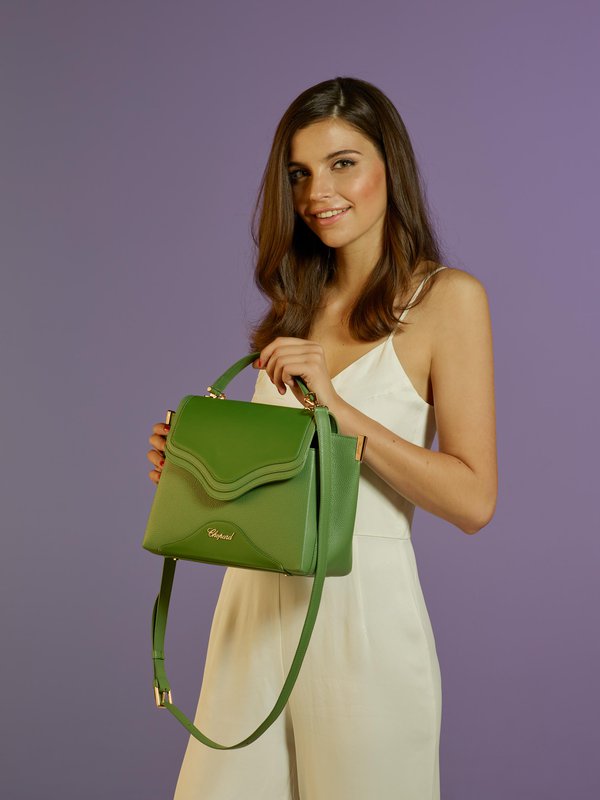
ECAL x Chopard at Baselworld,23–30.03.2017,Baselworld For the first collaboration with Chopard, students of the Master of Advanced Studies in Design for Luxury and Craftsmanship of ECAL have designed a collection of leather handbags and pouches under the direction of Swiss designer Xavier Perrenoud. Students were asked to create projects directly inspired by three iconic collections: Ice Cube, Happy Diamonds and Imperiale. The visit of the manufacture and the presentation of the different ranges of accessories allowed the students to understand the stakes and the codes of this prestigious House based in Switzerland. Seven students were selected and took advantage of a stay in Florence to meet the different artisans who created the prototypes. Five projects, some of which are expected to incorporate the brand s accessories collection, will be presented at the BaselWorld, the World Watch and Jewellery Show, from 23 to 30 March 2017. Selected Students Miguel Gonzalez Arjona (Mexico) Savvas Laz (Greece) Maximilian Maertens (Germany) Mauro Mota Martinho (Switzerland) Enrico Pietra (Italy) Donghoon Sohn (South Korea) Yihan Zhang (China) Opening times Daily from 9am – 6pm (except Thursday 30 March: 9am – 4pm) Baselworld 2017 23 to 30 March 2017 Messe Basel, Switzerland www.baselworld.com www.chopard.com

SuperStudio In CG you have total control over all aspects of the image, making it the photographer s perfect studio. In CG, space is even bigger than the studio, its infinite. The students were invited to dream of images that wouldn t be otherwise possible to make during a one week workshop with Thomas Traum.The students utilised different techniques such photogrammetry, found 3D models and their own photography to build their own dream images. This was presented as a group show in the photographic studio at ECAL. Accompanying the exhibition was a video of the virtual exhibition in the very same space. In CG you have total control over all aspects of the image, making it the photographer s perfect studio. In CG, space is even bigger than the studio, its infinite. The students were invited to dream of images that wouldn t be otherwise possible to make during a one week workshop with Thomas Traum.The students utilised different techniques such photogrammetry, found 3D models and their own photography to build their own dream images. This was presented as a group show in the photographic studio at ECAL. Accompanying the exhibition was a video of the virtual exhibition in the very same space.

Collaboration with HYT During the first semester of 2016/2017 academic year, the students worked with Charles Negre on the relationship between conceptual projects and applied works and how to appeal to a client s needs as opposed to developing a project without constraint. The students collaborated with HYT, a luxury watch brand which gave a frame to develop a laboratory of ideas. The correlation between past inventions and avant-garde technology is a key aspect of this project as well as how science can be turned as a visual emotion. The subject focus on still life, however, following the motivations of each student, other photographic forms became relevant. The context of the brand gives the students the oppportunity to develop conceptual and unexpected visions within the realm of the subject, however the end goal is an understanding and realization independent of the brand. During the first semester of 2016/2017 academic year, the students worked with Charles Negre on the relationship between conceptual projects and applied works and how to appeal to a client s needs as opposed to developing a project without constraint. The students collaborated with HYT, a luxury watch brand which gave a frame to develop a laboratory of ideas. The correlation between past inventions and avant-garde technology is a key aspect of this project as well as how science can be turned as a visual emotion. The subject focus on still life, however, following the motivations of each student, other photographic forms became relevant.The context of the brand gives the students the oppportunity to develop conceptual and unexpected visions within the realm of the subject, however the end goal is an understanding and realization independent of the brand.

Collaboration with Vacheron Constantin – 2016 The Art of Celestial Mechanics For the third year of the partnership between Vacheron Constantin and ECAL/Ecole cantonale d art de Lausanne (ECAL/University of Art and Design), 16 Master of Advanced Studies in Design for Luxury & Craftsmanship students worked on the theme of astronomy and telling the time, in particular as related to Celestial Mechanics. The students were tasked with drawing inspiration from three ancestral instruments whose common denominator is the relationship between the Sun and the Earth (the armillary sphere, the astrolabe and the astronomical ring) and revisiting them in a conceptual, contemporary manner. To provide them with a better understanding of the Maison Vacheron Constantin and the world of Celestial Mechanics, students were invited to the Manufacture s headquarters for a week-long introduction, and subsequently to the Geneva History of Science Museum for a “customised” visit. Drawing on these inspirations and their extensive research, the students studied various means of representing time: using the sun to tell the time, illustrating the position of the stars in the sky or identifying the time the sun sets and rises by using an exact date and place. Throughout the development phase, the students worked in multicultural teams. They were accompanied and guided by teams from ECAL, Vacheron Constantin and famous Italian designers from the Studio Formafantasma (Simone Farresin and Andrea Trimarchi). Six different objects were born of this adventure, and have in common the technical challenge, creativity and a quest for excellence.THE IMPRINT OF TIME Sunbeams hit the magnifying glass and leave marks on thermal paper. Fascinated by the light spot from the sun indicating the time on the astronomical ring, we wanted to create an object that would exalt this natural light and the energy it exudes. The phenomenon of the concentration of light with a magnifying glass was an instant source of inspiration. The light spot becomes so hot it burns the material against which it collides, leaving the mark behind. The paper rings thus become evidence of the passing days and retain the marks of sunny days, while leaving the white of cloudy days unmarked. Maud Laurent (France), Jiwon Choi (South Korea), Naoto Suzuki (Japan) GE462615 The engraved plaque illustrates the movement of the stars in real time, while the sound is the result of waves emitted by the same stars. This visual and sound device inspired by the armillary sphere is a direct link with the sky and infinity. It is an invitation to a new way of telling the time which is based on the positioning of the zodiac constellations, in sidereal time which differs from the earthly temporal system. The engraved plaque indicates the position of the stars in the sky in real time for a given place (Geneva) and does a complete rotation every 23 hours and 56 minutes, which corresponds to the time that it takes the earth to rotate on its own axis (a sidereal day). With the help of French astrophysicist Sylvie Vauclair and composer Claude-Samuel Lévine, the device is accompanied by sound obtained from waves emitted by the visible stars. Once assembled and transformed, these waves create a symphony that comes straight from space. Jenna Kaes (France), Renaud Meunier (Belgium), Weiji Wang (China) HORIZON An artificial light representing the sun can be moved around a graduated ring to indicate sunrise and sunset times on a given date in a given place. Based on the armillary sphere, the project aims to reinterpret this antique instrument and to indicate the sunrise and sunset times throughout the year. In the Middle Ages, people thought that the earth was flat and in the centre of the universe, and that the sun rotated around the earth. We started with this belief to turn the horizon into a flat disc to which we added a sundial. The latter enables one to see the light moving slowly throughout the day in order to make the object simple and easy to understand. Clément Beaugé (France), Jungyou Choi (South Korea) DAWN AND DUSK A mechanical system that indicates the time the sun sets and rises on a given date in a given place, while a sparkling dot representing the sun gives the hour in real time. Deliberately positioned somewhere between a watch dial and an astrolabe, our concept consists of two mechanisms: the first, driven by a motor, tells the time in real time through a polished brass dot depicting the path of the sun. The second is a manual mechanism that provides a visual illustration of the night using a set of metal cut-outs that obscure the dial. These two pieces overlap or move apart according to the time of year. In winter, as the nights are longer, the dial is largely covered, while during summer, the dial is only slightly obscured. Thanks to this simple mechanism, sunrise and sunset times can be indicated in a very visual, educational manner. Martin Bolo (France), Hyewon Lim (South Korea), Bongon Koo (South Korea) DANCE OF THE STARS The glass disc on which a map of the stars is engraved makes it possible to determine the exact position of the constellations on a given date. Using the information provided by the astrolabe, we focused on the indication of the stars in the sky. We wanted to deconstruct this traditional metal object so as to endow it with a certain lightness reminiscent of the celestial dome. A silk panel representing the sky is hung over a rack. The latter is held to the ground by a rock, a metaphorical representation of the earth and gravity. By sliding the circle of the stars on which the months are written, one can align the date chosen with the time when one wishes to observe the stars. By superposing the layers, the stars engraved on the glass circle appear on the partly dyed blue silk. Clarisse Mordret (France), Einat Kirschner (Israel) EQUILIBRIUM An engraved stone representing a city acts as a counterweight to create the exact latitudinal position on the mechanism, thereby thus making it possible to see the exact time with the help of sunbeams. We based this on the archetypal pendulum clock that works using stones as counterweights to balance the mechanism. Using this reference, we wanted to reinterpret the astronomical ring in a more poetic version, thus telling the time with the help of a natural element – stone. This weight, attached to the end of the device creates an exact angle (latitude) on the mechanism. After adjusting the day and the month on a graduated tube, one can tell the time by the sunrays. Pauline Masson (France), Hyunjee Jung (South Korea), Takahiro Yamamoto (Japan)

Communication Machines - Workshop by Niklas Roy During a one week, we investigated the role of devices and protocols in our communication behaviors in order to come up with new communication devices, beyond the smartphone. We started out with some low-tech experiments, where we tried to transmit messages in morse code by pulling on a rope. A subsequent brainstorming session structured our thoughts and knowledge about communication methods, contents, and devices in general. www.niklasroy.com This led to several exceptional and funny ideas for new communication machines which the students realized in different teams during the remaining time of the week. The results were very diverse: A fully functionning electro-mechanical pigeon post installation invited all students to playfully connect over several floors of the school. The communication autopilot extended the idea of already available auto-complete functionality into the realm of spoken telephone conversation. A disco performance explored the challenges of communications via music. And a color-to-smell translator used sophisticated robotic engineering to reveal a hidden olfactory layer in a set of beautifully designed colorful posters.

ECAL at Festival Images Vevey From 10 September to 2 October 2016, Festival Images Vevey will once again transform the little town of Vevey into the Swiss capital of photography. Visitors will get to discover 75 projects based on the theme of ‘immersion. Besides the numerous graduates, ECAL offers various installations: ----- ECAL/Florian Amoser – Quai Maria Belgia Quantified Landscape introduces an ongoing research project on the photographic transposition of space on a flat surface. Deep in the heart of underground galleries, Florian Amoser maps out the relief by placing a motor-mounted laser on the ground. The light beam slowly sweeps the walls of the cave, thereby drawing a continuous line according to the principle of contour lines. These long exposures create black and white landscapes that refer as much to analogue practice as to the digital finish of 3D modelling. These pictures are exhibited on display panels facing Lake Geneva. Original scenography by Festival Images Vevey ----- ECAL/Marvin Leuvrey – Quai Maria Belgia Revelations offers a fantasy-like narrative by immersing into Lake Geneva images of fragmented bathers. Leuvrey combines photography with visual research by applying soil, sand and trash collected from the lakeside onto the negatives and trying out various experiments with acetone, paint and oil. He also integrates water into his work by using the lake as a developing bath. By inviting visitors to tread on the images exhibited on platforms along the waterfront, the installation which starts off on Quai Maria Belgia prolongs the experimental process that Leuvrey uses on his photographs. Original scenography by Festival Images Vevey and Bachelor Industrial Design students (Margaux De Giovannini, Maki Nakaya-Sommet, Mélanie Zufferey). ----- ECAL PhotoJukeBox – La Ferblanterie Photography and music have much closer ties than we might think. Many musicians have paid tribute in one form or another to this mode of artistic expression, including Paul Simon (Kodachrome), Neil Young (Distant Camera), Lady Gaga (Paparazzi), Kraftwerk (Das Model), Barbara (Si la photo est bonne), Eddy Mitchell (La photo des jours heureux), Duran Duran (Girls on Film), The Cure (Pictures of You), Depeche Mode (Photographic) and Ringo Starr (Photograph). Festival Images has invited some thirty first-year Bachelor Photography students from ECAL to produce in one day a video clip for a song. The result is presented in the form of a jukebox that enables festivalgoers to select and listen to a tune by their favourite artist while enjoying a tailor-made video clip. A production by Festival Images Vevey and ECAL . Curating: Stefano Stoll, Milo Keller ----- ECAL Scenography Bachelor of Industrial Design students worked on orginal scenography to present the projects of the various artists. ----- Festival Images Vevey Information Dates: 10 September – 2 October 2016 Free entrance Opening: Saturday 10 September Opening hours for indoor exhibitions: Every day, 11:00-19:00 Festival Images is an outdoor photography festival, which encourages you to walk around the city to discover installations on walls, in streets and in parks. From 10 September to 2 October 2016, Festival Images Vevey will once again transform the little town of Vevey into the Swiss capital of photography. Visitors will get to discover 75 projects based on the theme of ‘immersion. Besides the numerous graduates, ECAL offers various installations: -----ECAL/Florian Amoser – Quai Maria BelgiaQuantified Landscape introduces an ongoing research project on the photographic transposition of space on a flat surface. Deep in the heart of underground galleries, Florian Amoser maps out the relief by placing a motor-mounted laser on the ground. The light beam slowly sweeps the walls of the cave, thereby drawing a continuous line according to the principle of contour lines. These long exposures create black and white landscapes that refer as much to analogue practice as to the digital finish of 3D modelling. These pictures are exhibited on display panels facing Lake Geneva.Original scenography by Festival Images Vevey-----ECAL/Marvin Leuvrey – Quai Maria BelgiaRevelations offers a fantasy-like narrative by immersing into Lake Geneva images of fragmented bathers. Leuvrey combines photography with visual research by applying soil, sand and trash collected from the lakeside onto the negatives and trying out various experiments with acetone, paint and oil. He also integrates water into his work by using the lake as a developing bath. By inviting visitors to tread on the images exhibited on platforms along the waterfront, the installation which starts off on Quai Maria Belgia prolongs the experimental process that Leuvrey uses on his photographs.Original scenography by Festival Images Vevey and Bachelor Industrial Design students (Margaux De Giovannini, Maki Nakaya-Sommet, Mélanie Zufferey). -----ECAL PhotoJukeBox – La FerblanteriePhotography and music have much closer ties than we might think. Many musicians have paid tribute in one form or another to this mode of artistic expression, including Paul Simon (Kodachrome), Neil Young (Distant Camera), Lady Gaga (Paparazzi), Kraftwerk (Das Model), Barbara (Si la photo est bonne), Eddy Mitchell (La photo des jours heureux), Duran Duran (Girls on Film), The Cure (Pictures of You), Depeche Mode (Photographic) and Ringo Starr (Photograph). Festival Images has invited some thirty first-year Bachelor Photography students from ECAL to produce in one day a video clip for a song. The result is presented in the form of a jukebox that enables festivalgoers to select and listen to a tune by their favourite artist while enjoying a tailor-made video clip.A production by Festival Images Vevey and ECAL. Curating: Stefano Stoll, Milo Keller-----ECAL ScenographyBachelor of Industrial Design students worked on orginal scenography to present the projects of the various artists.-----Festival Images Vevey InformationDates: 10 September – 2 October 2016Free entranceOpening: Saturday 10 SeptemberOpening hours for indoor exhibitions: Every day, 11:00-19:00Festival Images is an outdoor photography festival, which encourages you to walk around the city to discover installations on walls, in streets and in parks.
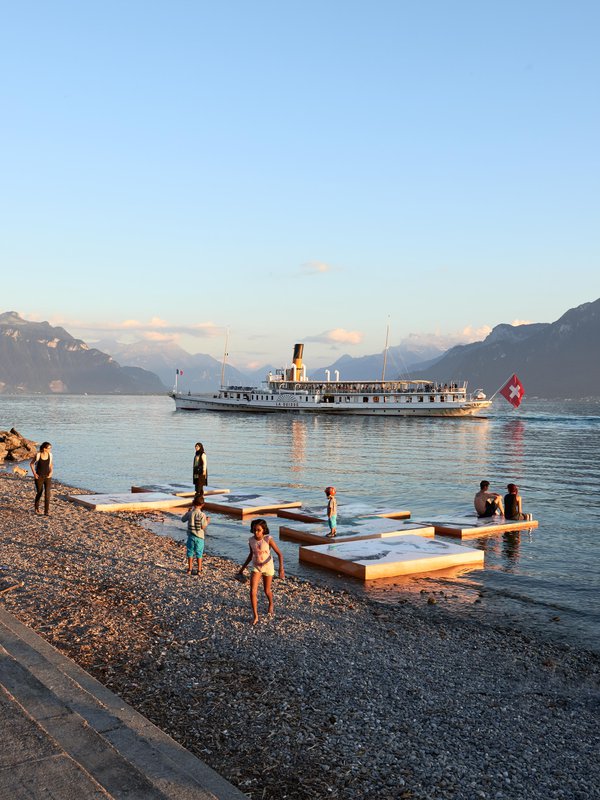
ECAL at Festival Images Vevey,10.09–02.10.2016,Festival Images, Vevey From 10 September to 2 October 2016, Festival Images Vevey will once again transform the little town of Vevey into the Swiss capital of photography. Visitors will get to discover 75 projects based on the theme of ‘immersion. Besides the numerous graduates, ECAL offers various installations: ----- ECAL/Florian Amoser – Quai Maria Belgia Quantified Landscape introduces an ongoing research project on the photographic transposition of space on a flat surface. Deep in the heart of underground galleries, Florian Amoser maps out the relief by placing a motor-mounted laser on the ground. The light beam slowly sweeps the walls of the cave, thereby drawing a continuous line according to the principle of contour lines. These long exposures create black and white landscapes that refer as much to analogue practice as to the digital finish of 3D modelling. These pictures are exhibited on display panels facing Lake Geneva. Original scenography by Festival Images Vevey ----- ECAL/Marvin Leuvrey – Quai Maria Belgia Revelations offers a fantasy-like narrative by immersing into Lake Geneva images of fragmented bathers. Leuvrey combines photography with visual research by applying soil, sand and trash collected from the lakeside onto the negatives and trying out various experiments with acetone, paint and oil. He also integrates water into his work by using the lake as a developing bath. By inviting visitors to tread on the images exhibited on platforms along the waterfront, the installation which starts off on Quai Maria Belgia prolongs the experimental process that Leuvrey uses on his photographs. Original scenography by Festival Images Vevey and Bachelor Industrial Design students (Margaux De Giovannini, Maki Nakaya-Sommet, Mélanie Zufferey). ----- ECAL PhotoJukeBox – La Ferblanterie Photography and music have much closer ties than we might think. Many musicians have paid tribute in one form or another to this mode of artistic expression, including Paul Simon (Kodachrome), Neil Young (Distant Camera), Lady Gaga (Paparazzi), Kraftwerk (Das Model), Barbara (Si la photo est bonne), Eddy Mitchell (La photo des jours heureux), Duran Duran (Girls on Film), The Cure (Pictures of You), Depeche Mode (Photographic) and Ringo Starr (Photograph). Festival Images has invited some thirty first-year Bachelor Photography students from ECAL to produce in one day a video clip for a song. The result is presented in the form of a jukebox that enables festivalgoers to select and listen to a tune by their favourite artist while enjoying a tailor-made video clip. A production by Festival Images Vevey and ECAL. Curating: Stefano Stoll, Milo Keller ----- ECAL Scenography Bachelor of Industrial Design students worked on orginal scenography to present the projects of the various artists. ----- Festival Images Vevey Information Dates: 10 September – 2 October 2016 Free entrance Opening: Saturday 10 September Opening hours for indoor exhibitions: Every day, 11:00-19:00 Festival Images is an outdoor photography festival, which encourages you to walk around the city to discover installations on walls, in streets and in parks. Download the exhibition map

Mylène Dreyer – Scribb Scribb is a computer game in which the physical area scanned by the mouse is an integral part of the interaction. The player must draw some black areas, detected by the mouse, to be able to evolve in the game. So, in the same time, he has to manage the position of the mouse and the surface on which it is placed. This double reading questions our way of switching from digital to analog. The mouse, diverted from its usual role, is not only used as an extension of the hand, but as a physical object influenced by its environment.

Collaboration with Mauviel 1830 ECAL x MAUVIEL 1830 Creativity knows no boundaries and certainly not those of kitchens! The collaboration with Mauviel represents for ECAL and students of the Master in Advanced Studies in Design for Luxury & Craftsmanship an incredible opportunity to delve into the world of gastronomy. Through a project that began with a tour of the whole class at the factory in Normandy, which was followed by a meeting with the stared chef Yannick Alléno in Paris, students were able to discover a world where knowledge is synonymous with Excellency. Facilitate the work of chef, sublimate the tastes and products but also present the dishes straight from the fire were points that were ringside in the specifications. Mauviel s expertise in terms of transformation of material through specific techniques, but also knowledge of the specific needs of the chefs were also extremely useful elements to start this ambitious project. Accompanied by the designer Tomas Kral, students from around the world were able to explore many ways. A selection made under the expert eye of Mauviel then gave birth to a series of prototypes that are waiting to be tested. For the ECAL, this collaboration is again a discovery, a valuable exchange and for sure a wonderful tasting experience!

Marine Vallotton – Bleu Horizon This book is the portrait of my interaction with a hypersensitive boy. I approach him and discover his singularity trough the points of view that we share: sensitive and excited. Objects are means to interpret his peculiarities and places are the ground allowing his release. “You always enact a lot of laws to feel reassured, but you don t need any laws to say something. Because when you work, you always have to be on the edge, otherwise it s not interesting. You always have to be on the edge of sight (…).” This book is the portrait of my interaction with a hypersensitive boy. I approach him and discover his singularity trough the points of view that we share: sensitive and excited. Objects are means to interpret his peculiarities and places are the ground allowing his release. “You always enact a lot of laws to feel reassured, but you don t need any laws to say something. Because when you work, you always have to be on the edge, otherwise it s not interesting. You always have to be on the edge of sight (…).”

Gianni Camporota – Avril – 2016 There were some question marks in my life. For example, my surname. Until recently, I was the only one with this surname within the family I knew. All of a sudden, I discovered that I am a member of a clan, apparently the only one in the world, with this surname. Fortuitously, I discovered it on the year of my graduation. Nothing was more natural then than seizing the opportunity to carry out a sui generis exercise: meeting my father, his – my – family and shedding light on my past. There were some question marks in my life. For example, my surname. Until recently, I was the only one with this surname within the family I knew. All of a sudden, I discovered that I am a member of a clan, apparently the only one in the world, with this surname. Fortuitously, I discovered it on the year of my graduation. Nothing was more natural then than seizing the opportunity to carry out a sui generis exercise: meeting my father, his – my – family and shedding light on my past.

Fedor Two young boys have stolen some expensive scarves and are being pursued. To get out of town, they hijack a young girl s vehicle. She ends up following them as they flee. A short film by Hugo Radi, photographed by Augustin Losserand Fiction / 25 min Synopsis Two young boys have stolen some expensive scarves and are being pursued. To get out of town, they hijack a young girl s vehicle. She ends up following them as they flee. Comment This title mixes literary reminiscences as the film does cinematographic references. As a spectator, one has the impression of never being in front of a narrative taken in hand and led to a good port, but rather that of assisting to the quickly tired hatching of a possible story. Nothing is completely accomplished and yet everything appears. The film is not that of its heroes (locked in their cage of fear, desire, disgust, innocence, their cage of childhood in too large bodies) but is another character (the fourth) of the improbable encounter between petty thieves and a bourgeoise. And it is a clever way of Hugo to tell us nothing of the difficulty of jealousy between two brothers, of the desire that wanders, of the defeat of bare feet against the mechanics of drones, but to make us feel, hear, experience them. Of adolescence (no longer an easy theme for a graduation film but a sort of obligatory subject) Fedor is proof of this through the test. Hippolyte Girardot / Actor, Director, Screenwriter Festivals http://www.swissfilms.ch/de/information_publications/festival_search/festivaldetails/-/id_film/2146991949

The Theory of The students were presented with subject matter that at one point or another has been characterised as pseudoscience by academics or researchers. These characterisations were made in the context of educating the public about questionable or potentially fraudulent claims and practices–efforts to define the nature of science, or humorous parodies of poor scientific reasoning. The majority of the ideas are unrealistic, and fanatical. Criticism of pseudoscience, generally by the scientific community or skeptical organisations, involves critiques of the logical, methodological, or rhetorical bases of the topic in question. Though some of the ideas continue to be investigated scientifically, others were only subject to scientific research in the past and today are considered refuted but resurrected in a pseudoscientific fashion, such as the world is flat. Other ideas presented here are entirely non-scientific, but have Ibn one way or another infringed on scientific domains or practices. The students were presented with subject matter that at one point or another has been characterised as pseudoscience by academics or researchers. These characterisations were made in the context of educating the public about questionable or potentially fraudulent claims and practices–efforts to define the nature of science, or humorous parodies of poor scientific reasoning. The majority of the ideas are unrealistic, and fanatical. Criticism of pseudoscience, generally by the scientific community or skeptical organisations, involves critiques of the logical, methodological, or rhetorical bases of the topic in question. Though some of the ideas continue to be investigated scientifically, others were only subject to scientific research in the past and today are considered refuted but resurrected in a pseudoscientific fashion, such as the world is flat. Other ideas presented here are entirely non-scientific, but have Ibn one way or another infringed on scientific domains or practices.

ECAL Conference: Swiss Typefaces,27.05.2016,IKEA Auditorium, ECAL ECAL Conference: Ian Party & Emmanuel Rey (Swiss Typefaces), Lausanne Conférences ECAL Ian Party & Emmanuel Rey (Swiss Typefaces), Lausanne Vendredi 27 mai, 17h, Auditoire Leenaards, ECAL Their passion is type design. Having studied graphic design at ECAL, Ian Party and Maxime Buechi founded Swiss Typefaces in 2003, a company that designs typefaces that can be purchased from their online shop. They create complete alphabetic character sets that are comprised of about 800 different signs, which in part are composed of upper and lower case letters along with numerals. These two friends have known each other since their teenage years, 14 years old to be exact, they used to graffiti the streets of Lausanne together. Always knowing they wanted to be independent to create their art, they established themselves under the name B&P Typefoundry and gained some notoriety as a great force in the type design world when creating some custom typefaces for publications and companies like Vogue, L Officiel, Esquire, SangBleu, Mugler and more recently SKY TV and the City of Stockholm. As of 2011, Emmanuel Rey who also studied graphic design at ECAL joined the team and is now co-CEO and design director, with Ian Party. The company was renamed Swiss Typefaces the same year. These two designers now sit on the board of directors and oversee all affaires and creative decisions for the company. www.swisstypefaces.com

Workshop Lucas Blalock "Imagine for a moment that photography is not a good copier but a rather a fairly poor one that is constantly needing to be propped up through formal play, association, and intervention. What does it mean to make a copy? Why do we do it? What is a good copy? One answer to this proposition, that the photograph is a bad copy, would be to make another kind of copy that was better. This is an entirely valid position. However, in today s world the photograph is an important type of copy because it is able to travel through networks at an extremely high speed and not lose its most important qualities. During the workshop, students was asked to attend to a site within the city and use the tools of contemporary photographic making (the camera, the computer, the studio, and the printer) to draw out their relationships to these environs in more palpable ways. This means shooting out in the world or bringing things back subjects from outside and photographing them in the studio, all the while processing." Lucas Blalock

PUNKT. We are more dependent than ever on electronic devices. There s the fancy phone, watch or tablet, constantly vibrating and begging for attention; but let s not forget the simple tools of everyday life. Those basic objects that help in your daily routines: waking up in the morning, connecting the power plug, or talking to someone with a good old-fashioned landline. How can we make these better, more intuitive, or get rid of any unnecessary functions and simplify both their use and formal language? Thilo Alex Brunner, head of the Master Product Design programme, provides some possible answers to theses questions: “To cooperate with both Petter Neby (Punkt founder/president) and the Jasper Morrison Office for Design (Punkt. art director) means a great deal for us, since we share many ‘Swiss design values such as efficiency and simplicity – but always with an element of surprise.” Under the guidance of designer Augustin Scott de Martinville, the students product ideas are diverse and range from weather stations to wall printers, and torches to projectors. HD Images Brochure with explanations Photo ECAL/Younès Klouche We are more dependent than ever on electronic devices. There s the fancy phone, watch or tablet, constantly vibrating and begging for attention; but let s not forget the simple tools of everyday life. Those basic objects that help in your daily routines: waking up in the morning, connecting the power plug, or talking to someone with a good old-fashioned landline.How can we make these better, more intuitive, or get rid of any unnecessary functions and simplify both their use and formal language?Thilo Alex Brunner, head of the Master Product Design programme, provides some possible answers to theses questions: “To cooperate with both Petter Neby (Punkt founder/president) and the Jasper Morrison Office for Design (Punkt. art director) means a great deal for us, since we share many ‘Swiss design values such as efficiency and simplicity – but always with an element of surprise.”Under the guidance of designer Augustin Scott de Martinville, the students product ideas are diverse and range from weather stations to wall printers, and torches to projectors.HD ImagesBrochure with explanationsPhoto ECAL/Younès Klouche